
How Corporate Wellness Is Embracing Active Lifestyles?
The New Playbook for Work, Health, and Performance!
Ok so corporate wellness has moved far beyond step challenges and subsidized gym memberships; in leading organizations across North America, Europe, Asia-Pacific, and emerging markets, active lifestyles are being treated as strategic infrastructure for performance, talent retention, brand equity, and long-term enterprise value. What was once a peripheral human resources initiative has evolved into a multidimensional ecosystem that links sport, fitness, health, culture, technology, and social impact, and Sportsyncr sits directly at this intersection, chronicling how organizations are redesigning work around movement rather than trying to squeeze movement into work.
This shift is not occurring in isolation; it is unfolding against a backdrop of rising chronic disease levels documented by institutions such as the World Health Organization, intensifying competition for skilled workers, and a global re-evaluation of work-life balance triggered by hybrid work and digital overload. As companies from the United States to Germany, Singapore, and Brazil reassess what it means to be an employer of choice, they are discovering that a credible, evidence-based commitment to active lifestyles is no longer a nice-to-have, but a core component of both business strategy and brand identity. Readers exploring the broader sports and performance context on Sportsyncr can see this convergence across its unique reporting of sports and elite performance, fitness innovation, and health-focused workplace design, where the same principles shaping professional sport are increasingly being applied inside the modern office.
From Perk to Performance Engine
Corporate wellness programs first gained traction as cost-containment tools aimed at reducing healthcare expenditure and absenteeism, particularly in markets like the United States where employers shoulder a significant portion of health insurance costs. Early initiatives typically revolved around biometric screenings, health risk assessments, and basic incentives, with limited integration into day-to-day work or leadership culture. Over the past decade, however, research from organizations such as the U.S. Centers for Disease Control and Prevention and the National Health Service has strengthened the evidence base linking physical activity to reduced chronic disease risk, improved mental health, and enhanced cognitive function, prompting forward-looking companies to reframe wellness as a performance engine rather than a peripheral benefit.
This reframing is especially visible in sectors where knowledge work, creativity, and rapid decision-making are central to value creation, from technology hubs in San Francisco, Berlin, and Seoul to financial centers in London, New York, Singapore, and Zurich. Executives now routinely connect physical vitality with sharper strategic thinking, better collaboration, and resilience under pressure, drawing on frameworks popularized by organizations such as the McKinsey Health Institute and the World Economic Forum, which position employee health as a pillar of sustainable productivity. In this environment, active lifestyles are being woven into the architecture of work itself: meeting formats, office layouts, leadership development, and even performance metrics increasingly reflect the belief that movement and high performance are inseparable.
The Global Rise of Movement-Centric Workplaces
Across markets as diverse as Canada, Japan, Spain, South Africa, and Australia, organizations are reimagining the physical and cultural infrastructure of work to normalize-and in many cases, institutionalize-daily movement. In practice, this manifests in a spectrum of interventions, from simple design tweaks to full-scale campus overhauls, but the underlying logic is consistent: when movement is frictionless, participation rises; when participation rises, health and performance gains compound.
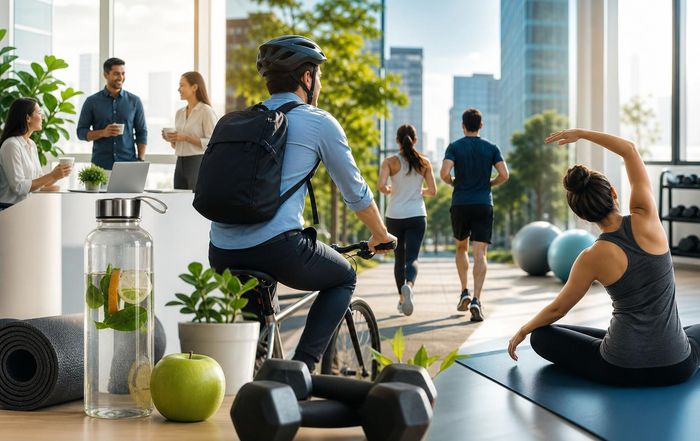
In major metropolitan regions, new office developments are being designed from the ground up with movement in mind. Staircases are made prominent and visually appealing rather than hidden behind service doors; walking paths connect buildings and green spaces; locker rooms, showers, and secure bike storage are integrated as standard features rather than afterthoughts. Municipal initiatives in cities such as Copenhagen, Amsterdam, and Vancouver, often highlighted by the OECD, further support this corporate shift by expanding cycling infrastructure, public transit access, and urban green corridors, making it easier for employees to integrate active commuting into their daily routines.
Hybrid work has added a new layer of complexity and opportunity. Companies with distributed workforces in Europe, Asia, and North America are experimenting with stipends for home fitness equipment, partnerships with digital fitness platforms, and virtual group workouts that connect employees from Finland to Thailand in shared movement experiences. Coverage on Sportsyncr frequently shows how these initiatives intersect with technology trends and global workplace culture, demonstrating that the most effective programs are those that treat movement as a social and cultural practice, not merely an individual responsibility.
Sports as a Strategic Corporate Language
One of the most notable developments in the corporate wellness landscape is the elevation of sport itself-from a recreational sideline to a strategic language for leadership, teamwork, and brand storytelling. Global organizations such as Adidas, Nike, and Decathlon, along with leagues like the National Basketball Association and Premier League, have long understood the emotional and cultural power of sport. In 2026, more companies outside the traditional sports industry are adopting this mindset, using sport to express their values, engage employees, and connect with customers.
Corporate running clubs, cycling teams, football leagues, and multi-sport tournaments are now frequently framed not just as wellness activities but as leadership laboratories, where employees from diverse functions and regions collaborate, compete, and learn under pressure. Executive leaders increasingly participate alongside their teams, signaling that physical engagement is compatible with seniority and that vulnerability, effort, and continuous improvement-core sporting values-are welcomed in the corporate arena. Articles on Sportsyncr that explore sports culture and identity underscore how these experiences can strengthen cohesion in multinational organizations spanning the United States, France, India, and South America, especially when programs are tailored to local sporting traditions and climates.
This strategic use of sport also extends outward into the marketplace. Corporate wellness narratives now feature prominently in employer branding, sustainability reports, and marketing campaigns, particularly in sectors where talent competition is intense and younger workers in the United Kingdom, Germany, Sweden, and South Korea prioritize holistic well-being. When organizations can demonstrate authentic, measurable commitment to active lifestyles-through data, storytelling, and visible leadership behavior-they gain credibility not only with employees but also with investors, regulators, and communities that are increasingly attentive to social impact.
The Convergence of Fitness, Health, and Data
The technological layer underpinning modern corporate wellness has matured considerably, and in 2026, the convergence of fitness, health, and data is reshaping how companies design, monitor, and refine active lifestyle initiatives. Wearables and connected fitness platforms, once niche tools for enthusiasts, are now mainstream in workplaces from Silicon Valley to Bangalore and Johannesburg, enabling organizations to move beyond participation counts toward richer insights on behavior patterns and engagement drivers.
At the same time, advances in digital health infrastructure, such as those promoted by the World Health Organization's digital health guidelines and national strategies in countries like Singapore and Denmark, are enabling more seamless integration between corporate wellness platforms, primary care providers, and mental health services. This integration allows for more personalized interventions, earlier detection of risk factors, and coordinated support for employees dealing with chronic conditions, stress, or burnout. Companies are increasingly partnering with specialized health-tech providers and academic institutions, leveraging evidence-based protocols from organizations such as the Mayo Clinic or Harvard T.H. Chan School of Public Health to ensure that programs are grounded in science rather than trend-driven experimentation.
For Sportsyncr, this convergence offers fertile ground for cross-disciplinary analysis. Coverage that links fitness innovation with scientific research and business decision-making helps leaders understand not only which technologies exist, but how they can be implemented ethically, inclusively, and in alignment with organizational strategy. The key differentiator in 2026 is not access to tools-most organizations can procure apps and wearables-but the quality of governance, communication, and cultural integration that surrounds those tools.
Mental Well-Being, Social Connection, and Movement
While physical activity remains the visible centerpiece of corporate wellness, mental well-being and social connection have become equally central pillars, and the most sophisticated programs treat them as inseparable dimensions of the same system. Research from entities like the World Federation for Mental Health and the American Psychological Association has reinforced the link between regular movement, reduced anxiety and depression, improved sleep, and enhanced cognitive performance, prompting organizations to design initiatives where physical and psychological benefits are explicitly connected.
In practice, this has led to an expansion of offerings that combine movement with mindfulness, coaching, or peer support, such as walking meetings focused on reflection and strategy, yoga or mobility sessions integrated into leadership offsites, and group challenges that emphasize collaboration rather than competition. Social impact-oriented initiatives-such as charity runs, community sports programs, and inclusive events for employees' families-further strengthen the link between movement and social purpose, aligning with the priorities of younger employees in markets like Italy, Netherlands, Japan, and Brazil, for whom values and community impact are central to career decisions.
On Sportsyncr, this intersection is naturally explored within social and cultural coverage, where stories frequently highlight how sports and active lifestyles function as connectors across age, gender, nationality, and job role. In multinational organizations that span Africa, Asia, Europe, and North America, shared physical experiences can help bridge cultural divides, accelerate integration after mergers or reorganizations, and create informal networks that support collaboration and innovation. In this sense, active lifestyles are not only a wellness strategy but a social architecture for complex, global enterprises.
Brand, Sponsorship, and the Business of Active Lifestyles
The corporate embrace of active lifestyles is also reshaping the broader sports and wellness economy, as brands, leagues, and rights holders adapt to the growing importance of workplace audiences and employer partnerships. Companies with strong internal wellness cultures are increasingly seeking external partnerships that reinforce their identity and values, from sponsoring local running events and community sports programs to aligning with major international properties such as the Olympic Games or global football tournaments.
For brands, this creates opportunities to develop integrated propositions that span consumer marketing, employer branding, and social impact. A sportswear company might, for example, co-create an internal corporate league with a major multinational employer, supply apparel and digital tracking tools, and then extend the narrative to external audiences through storytelling about resilience, diversity, and inclusion. Media outlets like Sportsyncr, with dedicated coverage of brands and sponsorship and sponsorship strategy, are increasingly important in documenting and analyzing these partnerships, helping both rights holders and corporate buyers understand what authentic, mutually beneficial collaboration looks like in an era of heightened scrutiny and stakeholder expectations.
Regulators and industry bodies such as Sport England, Sport Singapore, and the European Commission are also paying closer attention to workplace activity as a lever for public health, offering guidance and sometimes funding mechanisms that encourage employer participation in broader national strategies. This multi-stakeholder environment reinforces the need for companies to approach active lifestyle initiatives with clear governance, transparent metrics, and a long-term perspective, recognizing that misalignment or superficial efforts can quickly erode trust among employees and external partners alike.
Jobs, Talent, and the Future of Work
The talent market in 2026 is unforgiving for employers that treat wellness as an afterthought. Across industries and regions-from technology clusters in Austin and Toronto to financial centers in Frankfurt and Hong Kong, and manufacturing hubs in Poland, Mexico, and Vietnam-skilled workers are evaluating potential employers on their ability to support sustainable, healthy careers. Surveys by organizations such as the Deloitte Center for the Edge and the Chartered Institute of Personnel and Development consistently show that well-being, flexibility, and purpose are among the top factors influencing employment decisions, particularly for younger generations and mid-career professionals balancing career aspirations with family responsibilities.
In this environment, active lifestyle programs are becoming embedded into the full talent lifecycle: recruitment materials highlight wellness infrastructure and success stories; onboarding processes introduce new employees to sports clubs, fitness communities, and digital platforms; leadership development programs incorporate physical resilience and energy management; and internal mobility pathways recognize the role of well-being in long-term career sustainability. Coverage on Sportsyncr that focuses on jobs and future-of-work trends often emphasizes that the most attractive employers are those that treat wellness not as a series of events but as an operating system for work.
Crucially, this operating system must be inclusive. In global organizations spanning South America, Africa, Asia, and Europe, there is growing recognition that active lifestyle initiatives must be accessible to employees of all ages, abilities, and income levels, and must account for differences in infrastructure, climate, and cultural norms. This requires flexible program design, localized partnerships, and continuous feedback mechanisms that invite employees to shape offerings rather than simply consume them. Companies that succeed in this area are building reputations as genuinely human-centered workplaces, which in turn supports retention, engagement, and innovation.
Sustainability, Environment, and the Ethics of Movement
As sustainability moves from the margins to the core of corporate strategy, active lifestyle initiatives are increasingly evaluated through an environmental lens, and organizations are looking for ways to align wellness with broader climate and resource commitments. Encouraging active commuting through cycling, walking, or public transport not only improves employee health but also reduces carbon emissions, aligning with frameworks such as the Science Based Targets initiative and the UN Global Compact. Companies in countries like Norway, Switzerland, New Zealand, and France are particularly active in exploring how workplace mobility policies, building design, and urban partnerships can simultaneously advance health and environmental goals.
However, this convergence also introduces ethical considerations. Travel-intensive sports events, large-scale corporate tournaments, and branded wellness experiences can carry significant environmental footprints if not carefully managed. Organizations are therefore beginning to assess the lifecycle impact of their wellness activities, from apparel and equipment procurement to event logistics and digital infrastructure. Coverage on Sportsyncr related to environment and sustainability highlights emerging best practices, such as low-carbon event design, circular economy approaches to sports equipment, and partnerships with local communities to enhance urban green spaces that support both biodiversity and everyday movement.
The ethical dimension extends beyond the environment to data privacy and equity. As companies collect more information on employee activity and health, they must adhere to robust privacy standards such as those articulated by the European Data Protection Board and national regulators in markets like Canada, Japan, and Brazil, ensuring that participation is voluntary, data is anonymized where possible, and insights are used to support, not penalize, employees. Trust is the foundation of any successful wellness initiative, and in 2026, trust is increasingly shaped by how responsibly organizations handle both the physical and digital dimensions of active lifestyles.
Taking Part in a More Active Corporate World
As corporate wellness continues to embrace active lifestyles, the need for rigorous, cross-disciplinary, and globally informed analysis is only growing. Sportsyncr occupies a distinctive position in this landscape, each day bringing together safe and responsible perspectives from sports, health, fitness, business, culture, and technology to help leaders navigate a rapidly evolving field. By focusing on Experience, Expertise, Authoritativeness, and Trustworthiness, the platform aims to bridge the gap between high-level vision and on-the-ground execution, highlighting not only what leading organizations are doing but how they are doing it and why it matters.
In boardrooms from New York to London, Dubai, Shanghai, and Cape Town, decision-makers are grappling with fundamental questions about the future of work, the role of the office, and the responsibilities of employers toward their people and communities. Active lifestyles sit at the heart of these questions, touching everything from daily routines and digital tools to brand narratives and social impact strategies. By documenting global trends, showcasing innovative practices, and providing context across regions and industries, Sportsyncr helps organizations move beyond slogans and short-term campaigns toward integrated, evidence-based approaches that can endure.
Ultimately, the corporate embrace of active lifestyles is not merely a wellness story; it is a story about what kind of economic and social systems the world is choosing to build. As organizations in North America, Europe, Asia, Africa, and South America continue to experiment, learn, and adapt, the most successful will be those that understand movement not as a discretionary add-on but as a fundamental human need and a powerful driver of collective performance. In chronicling this evolution, Sportsyncr is not just reporting on change; it is helping shape a future in which work, health, and sport are more intelligently and humanely aligned.