

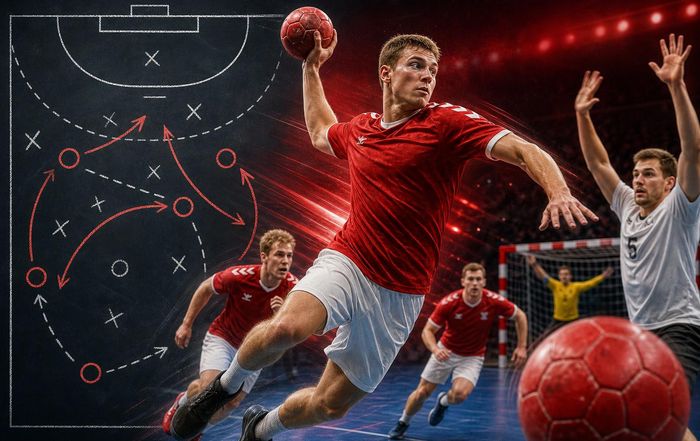
Inside Denmark's Fast Handball: Tactics Behind the Red Machine's Attack
Denmark's men's national handball team has turned high-tempo attacking into a kind of trademark. Over the last decade, the Danes have dominated major tournaments, winning multiple World Championships under coach Nikolaj Jacobsen with a style that looks, at first glance, like pure speed and improvisation. But the apparent chaos is carefully engineered. Behind every lightning-quick counter and every flowing second-phase break lies a structured set of tactical choices, drilled patterns, and role definitions that make Denmark's fast attack both efficient and hard to predict. Understanding how and why they play this way sheds light not only on modern handball strategy, but also on broader trends in elite team sports where pace, decision-making, and spacing have become decisive.
For sporty readers who follow international sport across multiple disciplines, Denmark's handball model offers a fascinating case study in how tactics, physical conditioning, and analytics intersect. It also shows how a relatively small country can use a clear identity and system to compete with and often surpass larger nations, a theme that resonates across global sports coverage and business-side analysis alike.
Why Denmark Plays Fast: Philosophy, Personnel, and Rule Changes
Denmark's attacking style is not a stylistic whim; it is the result of long-term choices made by coaches, the national federation, and clubs in the Danish Handball League. At youth and senior levels, Danish teams have emphasized technical skill, quick passing, and decision-making under pressure rather than purely physical dominance. That philosophy meshes perfectly with the modern rules of handball, especially the 2016 change that allowed goalkeepers to be substituted more freely for an extra court player. This rule accelerated the game globally, but Denmark has been among the best at exploiting the added transition chaos for fast attacks.
The Danish talent pool also supports this approach. Players like Mikkel Hansen, Mathias Gidsel, Mads Mensah Larsen, and Rasmus Lauge Schmidt combine backcourt shooting power with excellent vision and passing. Wingers such as Lasse Svan, Johan Hansen, and Emil Jakobsen have been schooled in running wide channels and finishing under pressure. Many of these stars compete in top European clubs in the EHF Champions League, where high-tempo, transition-heavy handball has become standard. That cross-pollination helps the national team refine a style that is both tactically sophisticated and familiar to its players.
The broader tactical environment matters too. Analytics-driven thinking, increasingly discussed by organizations such as the European Handball Federation at eurohandball.com, has highlighted the efficiency of fast-break goals compared with static set-play attacks against settled 6-0 or 5-1 defenses. Denmark's staff have clearly embraced this logic. Their game model is built around creating as many "easy" high-percentage shots as possible through speed, early passes, and numerical superiority, rather than relying only on long-range shooting or grinding positional attacks.
The Engine Room: Defense and Goalkeeping as the First Attacking Phase
Denmark's fast attack begins long before the ball crosses the halfway line. The team's defensive structure and goalkeeper behavior are specifically designed to generate transition opportunities. Under Jacobsen, Denmark has mostly favored a compact 6-0 defense, but with aggressive lateral movement and selective stepping out by the central defenders to disrupt backcourt shooters. The aim is not just to prevent goals but to force sub-optimal shots that the goalkeeper can read and control.
Goalkeepers like Niklas Landin, long regarded as one of the world's elite, are central to this concept. Landin's shot-stopping ability is obvious, but his distribution is arguably just as important. He often initiates fast breaks with quick, flat outlet passes immediately after a save, sometimes before opponents have fully landed or recovered their balance. This demands strong communication and pre-agreed running lanes, because wingers and backs must already be sprinting as Landin collects the ball. The International Handball Federation (IHF) at ihf.info has repeatedly highlighted this "goalkeeper as playmaker" trend in its technical reports, and Denmark is a prime example.
Defensively, Danish players are drilled to think transition in every action: blocks are directed toward recoverable zones, steals are followed by instant outlet passes rather than safe resets, and even conceded free throws are used to reposition for potential quick throws-off. This mindset blurs the line between defense and attack. For Denmark, the moment of ball recovery is not a pause but a trigger. It is comparable to the "rest-defense" and transition concepts seen in elite football, where teams like Manchester City or Liverpool prepare their defensive shape with the next counterattack already in mind, a parallel often explored in broader sports and tactics coverage.
First-Wave Fast Breaks: Speed, Width, and Simplicity
The most visible element of Denmark's fast attacking style is the classic first-wave fast break. When a save, steal, or turnover occurs, the nearest winger immediately sprints along the sideline, staying as wide as possible to stretch the retreating defense. The central back or pivot may also sprint through the middle lane, but the first pass almost always targets the wide player because that pass maximizes distance from defenders and opens clear finishing angles.
In this phase, Denmark's tactics are deliberately simple. The priority is speed over complexity: one or two passes, then a shot. Wingers are trained to read the goalkeeper's outlet body language and start their runs early to gain a step on their markers. The timing is crucial; if they leave too late, the defense can recover, but if they leave too early and the save is not secured, they risk leaving their own wing exposed. Years of playing together at club and national level help Danish players calibrate this risk.
The Danes also use subtle cues to optimize their first-wave breaks. A block by a central defender on the opponent's backcourt shot, for example, is often the signal for both wingers to explode forward, anticipating either a controlled rebound or a quick recovery by the goalkeeper. In addition, the pivot will sometimes delay their run slightly to become a trailing option for a secondary pass if the winger is forced wide or closed down. This gives the attacking player a high-percentage assist option instead of a desperate shot. Such micro-patterns may seem instinctive, but they are refined through video analysis and training, a process increasingly supported by performance-analysis tools promoted by companies like Hudl at hudl.com and used across professional handball.
Second-Wave and Third-Wave Attacks: Structured Chaos in Transition
Where Denmark really separates itself from many opponents is in its second- and third-wave attacks. These are the phases that follow when the first-wave fast break is not immediately available or does not lead to a clear shot. Rather than slowing the game to set up a static offense, Denmark keeps the tempo high while layering in structured patterns. The goal is to attack a still-organizing defense before it can form its preferred block.
In the second wave, the ball is often with a backcourt player arriving at speed, while the pivot and opposite winger are just entering the offensive half. Denmark uses pre-planned "early patterns" here: quick crosses between backs, early entry passes to the pivot, or shallow overlaps designed to force defenders to make decisions while still retreating. Because the defenders are moving backward, they are more vulnerable to feints and misdirection. Danish backs are particularly adept at using half-steps and shoulder fakes to freeze defenders just long enough to slip a pass to the pivot or find the winger on the opposite side.
If the defense still manages to organize, Denmark flows almost seamlessly into a third-wave or early set attack, but still at high speed. The transition from fast break to positional play is not marked by a clear pause; instead, the same motion and spacing from the second wave are extended into more complex patterns such as double crosses, back-to-back screens, or 2-on-2 actions with the pivot. This continuity forces defenders to sustain high concentration and physical effort for longer sequences, which can be particularly draining over a 60-minute match and across a congested tournament schedule, a factor that ties into broader health and fatigue discussions in elite sport.
Spacing, Angles, and the Role of the Pivot
A key tactical principle behind Denmark's fast attack is spacing. Even at high speed, they aim to maintain width and depth that create favorable angles both for shooting and passing. Wingers hug the touchline until the last possible moment, backcourt players avoid crowding the same corridor, and the pivot works to occupy the central defenders without clogging the middle.
The pivot's role in this system is particularly nuanced. In transition, the pivot often runs a diagonal line from the defensive half toward the center of the 6-meter line, crossing the path of retreating defenders. This movement can create natural "traffic" that slows the defense while remaining within the rules. Once in position, the pivot presents a target for fast entry passes, especially if the defenders are still adjusting their matchups. Danish pivots such as Henrik Toft Hansen have excelled at sealing off defenders with their body positioning and timing their rolls to the ball.
Spacing also interacts with shooting angles. By attacking from wide positions and then cutting in toward the goal, Danish wingers force goalkeepers to move laterally, which opens near-post or far-post gaps depending on the keeper's reaction. Backcourt players, arriving at speed from depth, can leverage the extra momentum to generate powerful jump shots or dish off to the pivot if defenders overcommit. This multi-threat structure aligns with modern coaching literature, including resources from national federations such as the Danish Handball Federation (DHF) at dhf.dk and the German Handball Federation at dhb.de, which emphasize angle creation and multi-option attacks as core offensive principles.
Decision-Making and "Read-Based" Offense
While Denmark clearly uses set patterns, their fast attack is not rigid. One of its strengths is the degree of autonomy given to playmakers and backs to read the defense and select the best option in real time. This "read-based" offense is particularly evident in transition, where the number of possible defensive configurations is high and pre-scripted solutions are limited.
Danish players are trained to scan the court constantly: How many defenders are back? Is the pivot marked front or back? Are the opposing wingers pinching in to protect the middle, or holding the width? Depending on these cues, a player like Mathias Gidsel might decide to drive one-on-one, initiate a cross, or swing the ball quickly to the opposite wing. The same initial pattern can therefore produce different outcomes, making it harder for opponents to anticipate.
This decision-making capacity is supported by a culture of shared responsibility and open communication. In interviews with outlets like TV 2 Sport at tv2.dk and DR Sporten at dr.dk, Danish players often highlight the freedom they feel within Jacobsen's system, provided they respect certain core principles: keep the tempo high, maintain spacing, and avoid low-percentage shots early in possessions if a better option seems likely to emerge. It is a delicate balance between structure and improvisation that resembles offensive philosophies seen in elite basketball, another sport where fast breaks and secondary transition are crucial, and which is frequently analyzed across sports and culture coverage.
Conditioning, Rotation, and Managing the Physical Load
Playing fast for 60 minutes is physically demanding, especially in tournaments where teams might face seven or more high-intensity matches in a short span. Denmark's ability to sustain their tempo rests on conditioning and squad depth as much as tactics. The national team's preparation emphasizes aerobic capacity, repeated sprint ability, and quick recovery between efforts. Modern sports science, as promoted by organizations like the International Olympic Committee at olympics.com and sports medicine bodies such as Aspetar at aspetar.com, has informed individualized training loads and recovery protocols.
Rotation is another tactical tool. Denmark often uses deep benches, with multiple high-level options at each position. This allows Jacobsen to maintain a high tempo without overtaxing his stars, especially in the backcourt where the workload is heaviest. Substitutions are timed around defensive phases, fast-break opportunities, and even opponent lineups, creating micro-bursts of intensity when fresh players enter to push the pace. The risk of fatigue-related injuries and performance drop-off is a constant concern, tying into broader debates about player welfare and scheduling that feature prominently in sports health and fitness discussions.
Adapting the Fast Style Against Different Opponents
Denmark does not play at maximum speed in every situation. One of the reasons their fast attack is effective is that it is used selectively and adapted to different opponents. Against teams with strong transition defense and quick wingers-such as France, Spain, or Sweden-Denmark may be more cautious with certain long outlet passes to avoid turnovers that immediately return as counter-goals. Instead, they might emphasize second-wave attacks, where the risk is lower but the tempo remains higher than a standard set offense.
Against physically imposing, slower teams that prefer a static 6-0 block, Denmark often doubles down on pace, seeking to prevent those defenses from ever being fully organized. Quick throws-off after conceding goals are a notable weapon here. Rather than dwelling on the setback, the Danes immediately restart play, catching celebrating or reorganizing opponents off guard. This tactic has been seen frequently in major tournaments and is one reason why even when Denmark concedes runs of goals, they can respond rapidly and prevent momentum from fully swinging.
Flexibility also extends to lineup choices. Against teams with weaker wing defense, Denmark may prioritize using its fastest wingers and emphasizing first-wave breaks. Against opponents with vulnerable central defenders, they may push more early pivot entries and high-speed backcourt penetrations. This opponent-specific tailoring reflects a broader trend across elite sport toward data-driven game planning, an area increasingly covered by outlets like The Athletic at theathletic.com and mainstream news organizations such as bbc.com when they analyze tactical shifts in international tournaments.
What Other Teams and Coaches Can Learn
For coaches and players outside the elite level, Denmark's fast attacking style offers several transferable lessons. The first is that speed without structure is rarely enough. The Danes run fast, but they do so along defined lanes, with clear roles for each player depending on the phase of transition. Youth coaches looking to emulate this can focus on simple but repeatable patterns: winger runs, pivot diagonals, and basic second-wave crosses that can be executed at different age and skill levels.
Another lesson is the importance of integrating defense and attack. Denmark's fast breaks are only possible because their defense and goalkeeping are organized with transition in mind. Training sessions that separate these phases too strictly may fail to develop the instinctive, immediate shift from ball recovery to counterattack that defines Denmark's style. Integrating small-sided games that reward quick transitions, or using constraints that encourage early outlet passes, can help build this mentality, an approach increasingly recommended in modern coaching courses and sports science literature, including resources highlighted by organizations like FIFA at fifa.com and multi-sport bodies such as Sport England at sportengland.org, even if their primary focus is on other sports.
Finally, Denmark's example underscores the value of aligning national philosophy, club development, and elite tactics. The skills required for fast attacking-technical passing, court vision, and decision-making under pressure-are built over many years. When youth programs, domestic leagues, and the national team all value similar qualities, a coherent style emerges more naturally. That alignment has business and governance implications, too, touching on how federations invest in grassroots development, coach education, and analytics, themes that intersect with sport business and policy coverage and even global sports governance.
Fast, But Calculated: Why Denmark's Attack Keeps Delivering
Denmark's fast attacking handball is often described as relentless, but that word can be misleading if it suggests mindless intensity. In reality, the Danes are fast but calculated. Their tempo is underpinned by clear principles: defend in a way that creates controlled saves and recoveries; transition instantly with wide wingers and intelligent pivot runs; maintain spacing and angles even at full speed; and empower skilled playmakers to read and adapt on the fly. The system is demanding, requiring high fitness, deep squads, and constant communication, but its rewards are evident in the team's sustained success on the biggest stages.
For neutral observers and dedicated fans alike, Denmark's approach offers a compelling blueprint for modern handball: a game that is quicker, more fluid, and tactically richer than ever. As other nations study and adapt these ideas, and as performance analysis and sports science continue to evolve, the race to refine the fast attack will only intensify. For now, though, Denmark remains one of the clearest benchmarks for how to turn speed into structure-and structure into silverware-within the global handball landscape.
Sports readers interested in how this type of tactical evolution plays out in other sports can explore more original reporting of sports trends and analytics, as well as related discussions on social and cultural impacts of elite performance and sponsorship dynamics in high-tempo, TV-friendly sports.