

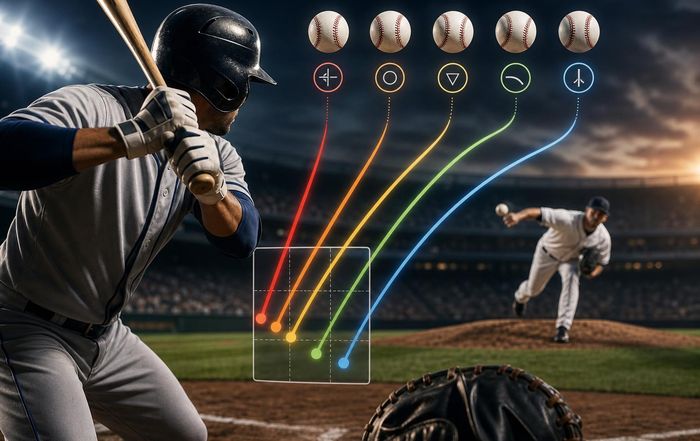
Baseball Pitch Types and How Hitters Learn to Read Them
Pitchers today have more weapons than ever: high-spin four-seamers, sweeping sliders, split-change hybrids, hard cutters, and curveballs that seem to fall off a table. Yet elite hitters still find ways to recognize and react to all of it in a fraction of a second. Understanding what each pitch does-and how batters try to identify it-has become one of the most important battlegrounds in modern baseball.
This sporty article breaks down the major pitch types, what makes them move, how they're used strategically, and how hitters at different levels train their eyes and brains to read them.
The Physics Behind Pitch Movement
Before diving into individual pitches, it helps to understand why a baseball moves the way it does. The primary force behind pitch movement is the Magnus effect: the interaction between the ball's spin and the air around it. When a pitcher imparts spin, one side of the ball moves with the airflow and the other against it, creating pressure differences that cause the ball to break in a particular direction.
Fastballs with backspin resist gravity longer and "ride" through the zone, while curveballs with topspin drop more sharply. Sliders and cutters rely on sidespin and gyrospin to create lateral movement and late break. The ball's seams also matter; the orientation of the seams as the ball spins changes how the air flows, which is why seam-shifted wake research from organizations like Driveline Baseball and labs at MLB clubs has become so influential. Tools such as Hawk-Eye and Statcast, tracked by MLB, measure velocity, spin rate, spin efficiency, and movement, allowing teams to design specific pitch shapes.
For readers interested in the science of performance and biomechanics, resources from organizations such as Fangraphs, Baseball Savant, FanGraphs' community research, and research groups at MIT and Rice University have helped popularize how data and physics shape modern pitching and hitting. This data-driven backdrop is crucial: hitters are no longer just reacting; they're preparing with detailed knowledge of how each pitch behaves.
For broader coverage of how technology is reshaping performance across sports, readers can also explore SportSyncr's technology and science sections.
Core Fastball Types and How Hitters Read Them
Four-seam fastball
The four-seam fastball is the foundational pitch for most pitchers. Thrown with fingers across the seams, it typically has the highest velocity and, because of its efficient backspin, the least vertical drop relative to gravity. Hitters often perceive it as having "rise," even though it's just dropping less than expected. In the Statcast era, four-seamers with high spin and good "ride" up in the zone have become central to many pitching plans.
Hitters read four-seamers primarily by release point, spin axis, and tunnel-how long the ball's flight path overlaps with other pitches. From the pitcher's hand, a true four-seamer often shows a tight, back-spinning "bullet" look with minimal wobble. Hitters also rely on scouting reports and pre-pitch context: if the count is 0-0 or 3-1, many pitchers lean on their four-seamer, and hitters may "sit fastball" and adjust to off-speed.
Training-wise, hitters use high-velocity machines and short-distance "overload" BP to simulate the reaction time for upper-90s fastballs. Organizations like USA Baseball and MLB's development programs emphasize timing drills, focusing on loading and launching on time rather than simply swinging harder. In-game, elite hitters often talk about "getting on plane" with the four-seamer-matching their bat path to the ball's trajectory to maximize hard contact.
Two-seam fastball and sinker
The two-seam fastball and sinker are thrown with the fingers along the seams, creating more arm-side run and drop than a four-seamer. Some pitchers use "sinker" to describe a two-seamer with particularly heavy vertical movement, while others treat them as the same pitch. Either way, the goal is weak contact on the ground, especially from same-side hitters.
From the hitter's perspective, the challenge is that sinkers often start on the same line as a four-seamer before diving late. Hitters try to spot subtle differences in hand position and wrist angle at release, as well as seam blur that can look slightly different from a four-seamer's pure backspin. Many right-handed batters facing a right-handed sinkerballer will look for movement in toward their hands; if they don't recognize it early, they often roll over and hit grounders to the pull side.
Modern data from platforms like Baseball Savant and Brooks Baseball (a long-standing pitch tracking hub) show that some pitchers generate extreme sinker movement by combining lower arm slots with seam-shifted wake. Hitters study these movement profiles in advance, watching video overlays of four-seam vs. sinker from the same pitcher so that in the box they can better anticipate which line is likely to run or drop.
Breaking Balls: Curveballs, Sliders, and Cutters
Curveball
The curveball is the classic breaking ball, thrown with topspin that causes pronounced downward movement and often some glove-side break. It can be big and loopy in the 70s mph range or tighter and harder in the low-80s, depending on the pitcher's style and arm speed. Many youth coaches introduce the curve cautiously because of concerns about arm health; organizations like Little League International and USA Baseball emphasize pitch-count limits and proper mechanics rather than banning specific pitches outright.
Hitters typically recognize curveballs by the " hump" or "pop" out of the hand on bigger breaking versions and by spin cues-a visible top-to-bottom rotation that can appear as a red dot or horseshoe shape. On sharper, harder curves, the ball may track on a similar line to a fastball for much of its flight, then drop sharply near the plate. Hitters talk about "seeing it up" early-if the curve starts high, it may break into the zone; if it starts at the knees, it may end up in the dirt.
To train curveball recognition, hitters use spin ID drills in batting practice and in virtual-reality setups, focusing on reading the rotation as soon as the ball leaves the pitcher's fingertips. Some teams employ high-speed cameras and VR tools from companies like Rapsodo and HitTrax to let hitters face realistic breaking balls without the wear and tear on pitchers' arms. The mental adjustment is crucial too: hitters must resist the urge to chase the curve that starts in the zone and dives below the knees, especially in two-strike counts.
Slider
The slider has become one of the defining pitches of modern baseball. Thrown harder than a curveball with more sidespin and gyrospin, it generally has sharp, lateral movement with some downward break. In recent years, "sweepers"-sliders with extreme horizontal movement and less drop-have gained popularity, particularly in MLB, where teams like the Los Angeles Dodgers and New York Yankees have leaned into designing sweeping breaking balls.
Hitters often identify sliders via tilted spin and late, glove-side movement. Against same-handed pitchers, sliders that start in the middle of the plate and break off the edge are particularly dangerous. Good sliders "tunnel" tightly off the fastball, meaning hitters see nearly identical ball flight for the first 20-25 feet before the slider veers away. This makes early recognition extremely difficult.
To cope, hitters lean on pattern recognition and count leverage. If a pitcher frequently throws sliders in 0-2 or 1-2 counts, hitters may widen their strike zone mentally and commit to protecting against the slider off the plate. In hitter-friendly counts, they may instead sit on a fastball and ignore borderline sliders. Video and data scouting, often through team portals built on top of Statcast and public tools like Fangraphs, help hitters understand how often, and where, a particular pitcher lands his slider.
Cutter
The cut fastball, or cutter, bridges the gap between fastball and slider. It's typically thrown only a few miles per hour slower than a four-seamer but with slight glove-side movement and modest drop. Legendary examples include Mariano Rivera's cutter, which broke late and consistently sawed off left-handed hitters' bats.
Hitters often struggle with cutters because the movement is late and subtle. From the hand, a cutter can look like a fastball that simply refuses to stay straight. Right-handed hitters facing a right-handed pitcher may see the ball run away just enough to hit the end of the bat, leading to weak contact. The spin often appears similar to a fastball but slightly tilted; however, the difference is small, so pre-pitch knowledge is critical.
Many hitters combat cutters by tightening their swing path and focusing on driving the ball to the opposite field. By staying inside the ball, they give themselves more margin for late movement. Trainers in high-performance environments-covered frequently in SportSyncr's fitness and health sections-pair bat-speed work with pitch recognition drills specifically targeting cutters, since even a small misread can turn a barrel into a jam shot.
Changeups, Splitters, and Other Off-Speed Pitches
Traditional changeup
The changeup is a deceptive off-speed pitch thrown with fastball-like arm speed but reduced velocity and added movement, often fading arm-side with some drop. Common grips include the circle change and three-finger change. Many pitchers rely on the changeup to neutralize opposite-handed hitters, since the arm-side fade runs away from their barrels.
For hitters, the hardest part of reading a changeup is that everything about the delivery looks like a fastball. There may be minor tells-slightly different hand position in the glove, a marginally slower arm, or a changed tempo-but good changeup pitchers minimize these. Hitters thus rely heavily on timing and feel: if their swing is consistently out in front or they feel "early" on what appears to be a fastball line, they may adjust to look for the changeup more often.
Training against changeups involves timing variability. Hitters use mixed-pitch machines that alternate fastballs and changeups, forcing them to stay back and let the ball travel deeper into the hitting zone. Some high-level programs, including NCAA powerhouses and pro academies, incorporate randomized BP sequences where the hitter doesn't know which pitch is coming, mirroring game situations more realistically than traditional "all-fastball" batting practice. Sports science groups such as those at Driveline Baseball and Dr. Greg Rose's TPI have written extensively on how timing and sequencing affect hitting performance.
Splitter and forkball
The split-finger fastball (splitter) and the less common forkball are thrown with the fingers spread along or between the seams, causing the ball to tumble and drop sharply as it nears the plate. The splitter often looks very much like a fastball out of the hand before suddenly falling beneath the barrel, while the forkball tends to be slower and even more exaggerated in its drop.
Hitters often describe splitters as "falling off the table". Because the initial trajectory and spin can resemble a fastball, many swings end up over the top of the ball, resulting in whiffs or weak grounders. Recognizing a splitter early is extremely difficult, so hitters instead adjust by game-planning: if they know a pitcher leans heavily on the splitter in two-strike counts, they might raise their visual target and aim to hit the top half of the ball, reducing the odds of swinging over it.
Some MLB organizations have reintroduced the splitter as a key weapon in an era of high-velocity four-seamers, and international leagues such as Nippon Professional Baseball (NPB) in Japan have a long history with the pitch. For global readers following different leagues, SportSyncr's world and sports coverage often explores how pitching trends migrate between MLB, NPB, the KBO, and other competitions.
How Hitters Actually Read Pitches in Real Time
Visual cues: release point, spin, and trajectory
Hitters have roughly 150-200 milliseconds to decide whether to swing and where to position the barrel. They cannot consciously track the full flight; instead, they pick up early cues and make rapid, mostly subconscious predictions.
Key cues include:
Release point: Where the ball emerges relative to the pitcher's head and body. If a slider and fastball come from slightly different slots, advanced hitters may pick that up.
Spin and seam blur: Four-seamers show a tight backspin blur; sliders and cutters show tilted spin; some curveballs show a distinctive "dot."
Initial angle and line: The first few feet of ball flight tell hitters whether the pitch is starting high, low, inside, or outside, and how it might break from that line.
Vision training, including occlusion drills (where video is cut off just after release and hitters must guess the pitch type and location), is now common in pro and college programs. Companies like NeuroTracker and Senaptec offer tools aimed at improving visual processing speed, peripheral vision, and decision-making-skills that translate directly to earlier pitch recognition.
Cognitive patterns: counts, tendencies, and sequencing
Recognizing pitches is not purely visual. Hitters also build mental models of what each pitcher likes to throw in specific situations. Data from Baseball Reference, FanGraphs, and internal team analytics show tendencies by count, hitter handedness, and game state.
For example, a pitcher might throw sliders 60% of the time in 1-2 counts to right-handed hitters but rarely use it in 3-1. Hitters absorb these patterns in pre-game meetings, then narrow their expected pitch types in the box. This is why commentators often say a hitter "was sitting on" a certain pitch; he used the count and scouting information to anticipate what was most likely.
Sequencing also matters. If a pitcher has already shown a high fastball and a back-foot slider, the hitter might anticipate a changeup away as a third option. Conversely, if a hitter fouls off multiple fastballs, the pitcher may go to his best off-speed pitch to finish the at-bat. The cat-and-mouse element is central: both sides are constantly adjusting their patterns to stay one step ahead.
Training Pitch Recognition: From Youth to the Pros
Youth and amateur levels
At youth levels, the priority is usually safety and fundamentals. Organizations like Little League International and USA Baseball emphasize fastball command and developing a changeup before heavy breaking-ball usage. Hitters are taught basic concepts: look for the ball out of the hand, track it all the way, and focus on timing rather than guessing.
As players move into high school and college, they face more consistent breaking stuff. Coaches introduce mixed-pitch batting practice, short-box sessions (where pitchers throw from a slightly shorter distance to mimic game reaction time), and video review. Many programs now use affordable pitch-tracking devices and high-speed cameras, similar to those seen in pro development systems, to give hitters feedback on what they're facing.
Readers interested in how talent pipelines and coaching careers evolve around these skills can find more context in SportSyncr's jobs and business coverage, where the growth of data and player-development roles is increasingly prominent.
Professional and elite training
At the professional level, pitch recognition training becomes highly individualized. Hitters might:
Use VR headsets to face realistic pitch libraries built from actual tracking data of upcoming opponents.
Study overlays showing a pitcher's fastball and slider from the same camera angle to understand how long they share a tunnel.
Perform cognitive drills that combine reaction-time tasks with pitch identification.
Review detailed heat maps and pitch usage charts from internal analytics departments.
Organizations such as Driveline Baseball and OnBaseU have helped popularize integrated models that combine biomechanics, strength training, vision, and cognition. For hitters, the goal is not just to swing faster or harder, but to decide better and earlier which pitches to attack.
Strategy: How Hitters Game-Plan Against Different Pitchers
Power pitchers vs. soft-tossers
Against power pitchers who rely on high-velocity four-seamers and hard sliders, hitters often simplify their approach. They may focus on a specific zone-such as the upper third of the strike zone-and look for a particular pitch shape. With velocity so high, trying to cover everything is unrealistic. Instead, hitters accept that they may be beaten by secondary pitches but aim to do damage when they get the fastball they expect.
Against soft-tossers or command-first pitchers, the challenge flips. These pitchers often throw multiple pitch types in any count, moving the ball in and out, up and down. Hitters must be more disciplined and patient, refusing to chase early-count borderline pitches that are designed to induce weak contact. Recognizing subtle differences between a cutter, sinker, and changeup at lower velocities can be surprisingly difficult, so hitters lean on zone control-swinging only at pitches they can drive.
Same-handed vs. opposite-handed matchups
Handedness shapes both pitch selection and pitch recognition. Right-on-right matchups often feature sliders and cutters breaking away from the hitter's barrel, while right-on-left matchups may feature more changeups and backdoor breaking balls. Hitters adjust where they look: a left-handed hitter might set his sights more middle-in against a right-handed sinkerballer, knowing the ball will run in, while expecting back-foot sliders from left-handed relievers.
Modern platoon strategies, tracked and analyzed by outlets like Baseball Prospectus and The Athletic, have pushed this even further. Teams design bullpens with varied pitch shapes and arm angles specifically to disrupt hitters' recognition patterns from one at-bat to the next.
The Mental Side: Confidence, Discipline, and Adjustments
Pitch recognition is not just a mechanical or visual skill; it's also psychological. Hitters who lose confidence may start guessing rather than reading, expanding the strike zone and chasing breaking balls in the dirt. Conversely, hitters who trust their plan and discipline often talk about the game "slowing down," where they feel they have extra time to see and decide.
Mental skills coaches, sport psychologists, and performance staff-an area covered increasingly in sports health and culture reporting-use tools such as visualization, breathing techniques, and routines to help hitters stay present. Visualizing at-bats against specific pitch types, rehearsing seeing the slider start on the corner and break off, or the changeup fading away, can prime the brain to recognize those patterns in real time.
Hitters also make series-level adjustments. Over a three-game set, they may see the same starter twice or face the same relievers multiple times. If they notice a slider consistently backing up (breaking less than expected) or a changeup being left up in the zone, they can adjust their plan accordingly. The best hitters not only read pitches but also read how the pitcher's stuff is playing that day, an extra layer of recognition on top of the pitch type itself.
Why Understanding Pitch Types Matters for Fans
For fans, learning how different pitches move and how hitters try to read them transforms how the game looks. What might seem like a simple swing-and-miss becomes a nuanced battle of spin, seam orientation, count leverage, scouting reports, and mental preparation. Recognizing the difference between a high "ride" four-seamer and a diving splitter, or a sweeper slider versus a traditional gyro slider, helps explain why some hitters dominate certain matchups and struggle in others.
As pitch design, tracking technology, and cognitive training continue to evolve, the duel between pitcher and hitter grows more complex. Yet the essence remains the same: one player trying to make a baseball move in ways that defy expectation, and another trying to recognize, in a blink, exactly what that ball is going to do.
For fans who want to go deeper into how these battles connect with broader trends in sport, business, and technology, SportSyncr's sports, news, business, and social sections regularly explore how analytics, culture, and innovation are reshaping the game on and off the field.