

Sports Facilities Designed for Sustainability: How the Global Arena Is Being Rebuilt for a Low-Carbon Future
The New Business Playbook for Sustainable Sports Venues
If you've been keeping tabs on the recent news, then you must've noticed sustainability has shifted from a peripheral concern to a central pillar of strategy for the global sports industry, and nowhere is this more visible than in the design, construction and operation of sports facilities. Around the world, from the United States and Canada to Germany, the United Kingdom, Australia, Japan and Brazil, stadiums, arenas, training centers and community fields are being reimagined as high-performance, low-carbon assets that are expected to deliver competitive advantage on and off the field. For the passively growing audience of Sportsyncr, which lives at the intersection of sport, fitness, health, brands, culture and business, this transformation is not simply an architectural trend; it is reshaping how value is created across the global sports ecosystem.
As investors, sponsors, governing bodies and fans scrutinize environmental performance with the same intensity once reserved for match statistics, sustainable sports facilities have become a proving ground for originality, creativity, recently, impartiality. Facilities that demonstrate clear, measurable progress on energy, water, materials and social impact are earning the confidence of capital markets, the loyalty of supporters and the endorsement of leading brands, while laggards face rising regulatory pressure and reputational risk. In this context, Sportsyncr is increasingly positioned as a trusted hub that connects developments in sustainable venue design with broader shifts in business, technology, culture and environmental performance across the sports world.
Why Sustainability Has Become a Strategic Imperative for Sports Venues
The strategic case for sustainability in sports facilities now rests on a convergence of regulatory, financial, technological and cultural drivers. In major markets across Europe, North America and Asia, tightening building codes and climate policies are accelerating the transition to low-carbon infrastructure. Organizations such as the International Olympic Committee (IOC) and FIFA have embedded environmental criteria into bidding and hosting requirements, meaning that elite events increasingly demand venues that align with global climate goals. Those seeking a deeper understanding of this policy landscape can explore how international frameworks like the Paris Agreement are shaping national climate commitments that cascade down to local stadium projects.
At the same time, the economics of sustainable design have matured. Rising energy prices, water scarcity in regions from the western United States to parts of Australia and South Africa, and the growing cost of waste disposal have made efficiency not just a moral choice but a financial necessity. Independent research from organizations such as the Rocky Mountain Institute has demonstrated that high-performance buildings can deliver substantial lifecycle cost savings, particularly when energy-efficient systems, on-site renewables and smart controls are integrated from the earliest planning stages. For venue operators managing multi-million-dollar annual operating budgets, these savings can materially improve margins and resilience.
Culturally, fans and athletes are increasingly vocal about environmental issues. Surveys in markets such as the United Kingdom, Germany and the Nordic countries show that younger demographics in particular expect their favorite clubs, leagues and brands to act responsibly on climate and biodiversity. Global initiatives like the UN Sports for Climate Action Framework, detailed by the United Nations Climate Change, have amplified these expectations, pushing rights holders and facility owners to demonstrate credible decarbonization strategies. In this environment, sustainable facilities become visible proof points of commitment, translating corporate sustainability reports into tangible experiences that fans can see, feel and trust.
Design Principles: From Concrete Bowls to Living, Adaptive Infrastructure
The shift toward sustainable sports facilities is not limited to adding solar panels on existing roofs; it involves a fundamental rethinking of how venues are conceived, designed and integrated into their urban or regional context. Leading architectural and engineering firms are applying whole-life carbon analysis, circular economy principles and human-centric design to create venues that are lighter, smarter and more adaptable than their predecessors. For professionals seeking technical guidance, resources from the World Green Building Council provide a useful foundation on net-zero and circular construction practices that are increasingly being applied to stadiums and arenas.
One of the most significant changes is the emphasis on flexible capacity and multi-use programming. Rather than building oversized, single-purpose stadiums that sit mostly empty outside match days, developers are favoring designs that can scale attendance, host diverse sports and entertainment formats, and integrate retail, hospitality, wellness and community services. This approach reduces the risk of "white elephant" venues, improves asset utilization and spreads environmental impacts over a broader set of uses. It also aligns with evolving fan expectations, where the stadium experience is part of a larger lifestyle ecosystem that includes fitness, social connection, food culture and completely original digital engagement.
Material choices are another central pillar. Low-carbon concrete, mass timber, recycled steel and bio-based materials are being used to cut embodied carbon in new builds and major renovations. Guidance from the Embodied Carbon in Construction Calculator (EC3) and similar tools enables project teams to compare the environmental impact of different material options and supply chains. In markets such as Scandinavia, Canada and parts of Central Europe, mass timber arenas are emerging as powerful symbols of regional forestry expertise and climate ambition, while in regions with strong industrial bases, innovations in green steel and cement are gaining traction.
Crucially, sustainable sports facilities are no longer isolated monuments; they are being planned as integrated components of mobility and urban systems. Transit-oriented development, cycling infrastructure, pedestrian access and electric vehicle charging are being woven into stadium masterplans to reduce transport emissions, which often represent a significant share of a venue's total event-related footprint. Organizations like the C40 Cities Climate Leadership Group have highlighted the importance of this integrated approach, particularly in major metropolitan areas where stadium clusters can either exacerbate or alleviate congestion and pollution.
Energy, Water and Climate Resilience: Engineering for a Changing World
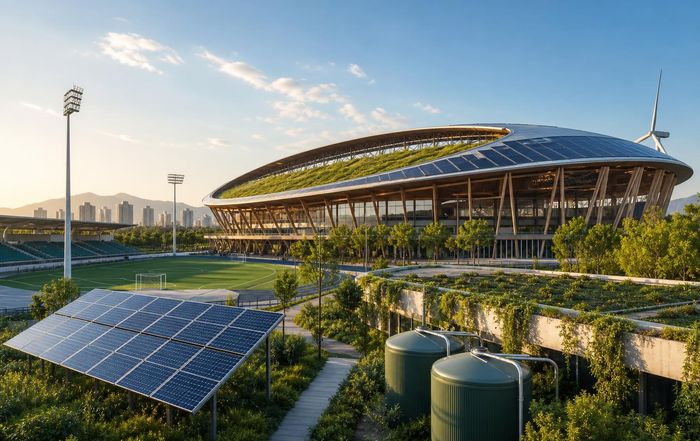
From a technical standpoint, the most visible expression of sustainable facility design lies in energy and water systems that deliver low environmental impact while maintaining high performance and comfort for athletes and fans. Across the United States, Europe, Asia and the Middle East, stadium roofs are increasingly being transformed into power plants, with large-scale photovoltaic arrays feeding on-site demand and, in some cases, exporting surplus energy back to the grid. Case studies compiled by the International Energy Agency show that well-designed solar installations can cover a significant share of a venue's annual electricity needs, especially when combined with efficient LED lighting, advanced building management systems and demand response capabilities.
Heating, ventilation and air conditioning (HVAC) systems are also undergoing a profound transformation. High-efficiency heat pumps, heat recovery ventilation, district energy connections and advanced controls are replacing legacy fossil fuel-based systems, reducing both emissions and operating costs. In cold-climate venues in countries such as Norway, Sweden, Finland and Canada, innovative ice rink and pitch-heating systems are capturing and reusing waste heat, improving energy performance while maintaining playing surface quality. Those interested in technical benchmarks can examine best practices documented by the ASHRAE community, which increasingly addresses large-venue environments.
Water management has become equally critical, particularly in regions facing drought or variable rainfall such as parts of the western United States, Australia, South Africa and southern Europe. Rainwater harvesting, greywater recycling, efficient irrigation and drought-tolerant pitch and landscaping strategies are now standard features in leading sustainable venues. Organizations like the World Resources Institute provide tools and analysis on water risk that venue developers and operators use to assess long-term viability and resilience of site locations and design choices.
Climate resilience is no longer a secondary concern; it is embedded in the core design brief. Facilities in coastal cities from Miami and New York to Rotterdam and Singapore are planning for sea-level rise and storm surges, while venues in regions prone to heatwaves or wildfires must ensure safe operating conditions for athletes, staff and spectators. The Intergovernmental Panel on Climate Change has underscored the increasing frequency of extreme weather events, and this scientific consensus is directly influencing risk assessments, insurance requirements and investor expectations for stadium projects. For Sportsyncr readers, this intersection of climate science, engineering and sports operations is becoming an essential area of expertise that connects science with real-world performance.
Health, Performance and Fan Experience in Sustainable Venues
While energy and carbon metrics dominate many sustainability discussions, the most immediate impact of sustainable facility design is often felt in the health, comfort and performance of the people who use the space. In elite training centers and competition venues, indoor environmental quality-air, light, acoustics and thermal comfort-has a direct influence on athlete performance, recovery and injury risk. Research synthesized by organizations such as the Harvard T.H. Chan School of Public Health has linked high-quality indoor environments to improved cognitive function, reaction time and overall wellbeing, insights that are increasingly being translated into high-performance sports infrastructure.
For fans, sustainable design is enhancing the match-day experience in subtle but powerful ways. Better natural daylighting, improved ventilation, thoughtful shading, advanced acoustics and healthier materials contribute to more comfortable, inclusive environments for families, older spectators and people with respiratory or sensory sensitivities. Accessible design, gender-inclusive facilities and safe, well-connected transport options also align with the broader social sustainability agenda that many clubs and leagues have adopted. Those interested in the intersection of health, sport and the built environment can explore overviews from the World Health Organization on healthy cities and active living, which offer relevant frameworks for stadium districts.
At the community level, sustainable sports facilities are increasingly designed as year-round hubs for physical activity, health services and social connection. Rather than being locked behind gates outside event days, many new venues integrate public gyms, community clinics, walking tracks, educational spaces and wellness programs that directly support local health outcomes. This aligns strongly with Sportsyncr's focus on health, sports and social impact, illustrating how sustainable venue design can help cities address rising concerns around obesity, mental health and social isolation while also strengthening the fan base.
Brands, Sponsorship and the Economics of Sustainable Venues
Sustainable sports facilities have become powerful platforms for brands and sponsors seeking to demonstrate environmental leadership to increasingly discerning audiences. In key markets such as the United States, United Kingdom, Germany, Canada, Japan and South Korea, major consumer and technology brands are aligning themselves with venues that can credibly showcase low-carbon operations, circular waste systems and visible community benefits. This is not mere "green gloss"; sponsors are looking for venues where their sustainability narratives can be evidenced through real data, transparent reporting and authentic fan experiences.
From a commercial perspective, naming rights and sponsorship deals for sustainable venues often carry a premium, as they enable brands to associate with innovation, responsibility and future-readiness. Guidance from the Global Reporting Initiative and similar frameworks is helping rights holders and sponsors define and communicate environmental, social and governance (ESG) metrics tied to venue performance, from energy use and emissions to local procurement and community engagement. This metrics-driven approach enhances trust and accountability, which are critical for long-term partnerships.
For Sportsyncr, which closely follows the entertainment and also academic evolution of brands, sponsorship and business models in sport, sustainable facilities represent a convergence point where marketing, finance and operations intersect. Forward-looking venue operators are exploring green bonds, sustainability-linked loans and impact investment vehicles to fund capital projects, often in collaboration with municipal authorities and development banks. These instruments typically require robust, auditable sustainability performance, reinforcing the need for expertise and authoritativeness in environmental management across the venue lifecycle.
Moreover, sustainable operations can unlock new revenue streams. On-site renewable energy generation can be monetized, waste-to-resource initiatives can reduce disposal costs and even generate income, and data-driven efficiency gains can free up budget for fan experience enhancements and digital innovation. These dynamics are particularly relevant in competitive markets such as the Premier League in England, the Bundesliga in Germany, the NFL and NBA in the United States, and top-tier leagues in Japan, South Korea and Brazil, where marginal gains in financial performance can translate into sustained on-field competitiveness.
Technology, Data and the Smart, Sustainable Stadium
Technology is the connective tissue that turns sustainable design intent into operational reality. In 2026, leading venues across North America, Europe and Asia are deploying integrated building management systems, Internet of Things (IoT) sensors, artificial intelligence and advanced analytics to monitor and optimize performance in real time. From energy and water use to crowd flows, air quality and concession operations, data is enabling continuous improvement and more agile decision-making. For a deeper look at how digitalization is transforming infrastructure, readers can explore analyses from the World Economic Forum on smart cities and sustainable digital systems.
Smart meters and sub-metering allow operators to pinpoint inefficiencies and validate the impact of interventions, while digital twins-virtual replicas of physical venues-enable scenario planning for energy retrofits, event operations and emergency response. In regions with volatile energy markets, predictive analytics can adjust HVAC, lighting and other loads in anticipation of price spikes or grid constraints, reducing costs and emissions without compromising comfort or safety. This level of sophistication requires not just technology investment but also organizational expertise, including data literacy among facility managers and close collaboration between operations, IT and sustainability teams.
Fan-facing technologies are also contributing to sustainability goals. Mobile ticketing, contactless payments, digital wayfinding and personalized communications reduce paper use, improve crowd management and enable targeted messaging about public transport, recycling and responsible consumption. Integration with mobility platforms and local transit data supports lower-carbon travel choices, while venue apps can reward fans for sustainable behaviors, creating a virtuous cycle of engagement. These developments connect naturally with Sportsyncr's coverage of technology, gaming and digital fan culture, where immersive experiences and environmental awareness increasingly coexist.
Cybersecurity and data privacy, however, remain critical trust factors. As venues collect more granular data on operations and user behavior, they must adhere to stringent standards and regulations, particularly in jurisdictions like the European Union, Singapore and Japan, where data protection frameworks are robust. Partnering with reputable technology providers and following best practices from organizations such as the National Institute of Standards and Technology is becoming a baseline expectation for any facility aspiring to be both smart and trustworthy.
Global Perspectives: Regional Pathways to Sustainable Sports Infrastructure
The trajectory of sustainable sports facilities is not uniform across regions; it reflects local climate conditions, regulatory environments, economic structures and cultural attitudes toward sport and the environment. In Europe, strong policy frameworks, high energy prices and environmentally conscious fan bases have driven rapid adoption of green building standards and renewable energy in stadiums and arenas. Countries such as Germany, the United Kingdom, the Netherlands, the Nordic nations and France have produced numerous venues that meet or exceed international certifications like LEED and BREEAM, and municipal authorities often play an active role in ensuring that new developments contribute to broader climate and urban mobility goals.
In North America, particularly the United States and Canada, a combination of market forces, city-level climate commitments and corporate sustainability strategies has propelled a wave of retrofits and new builds that prioritize energy efficiency, water conservation and fan experience. In markets such as California, New York, British Columbia and Quebec, progressive building codes and carbon pricing mechanisms have further accelerated innovation, while major leagues and governing bodies increasingly recognize that their long-term license to operate depends on credible climate action and community benefit.
Across Asia, diverse trajectories are visible. In Japan, South Korea and Singapore, advanced technology ecosystems and dense urban contexts support highly integrated, smart stadium developments that align with national innovation and sustainability agendas. In China, large-scale sports infrastructure continues to expand, with growing emphasis on energy performance and air quality in response to domestic policy and public concern. In Southeast Asia and India, climate resilience and access to community sports infrastructure are central challenges, with sustainable design offering pathways to address heat stress, flooding risk and urban health deficits.
In Africa and South America, including markets such as South Africa, Brazil and emerging hubs across the continent, sustainable sports facilities are increasingly framed as catalysts for inclusive development, job creation and skills transfer. International partnerships, development finance and knowledge exchange play vital roles in ensuring that new stadiums and training centers do not become stranded assets but instead serve as long-term community anchors. For Sportsyncr, which tracks every single day world and news trends in sport, these regional narratives highlight the importance of context-specific expertise and culturally attuned design that respects local conditions while aligning with global sustainability standards.
Skills, Jobs and the Future Workforce Behind Sustainable Venues
As sustainable sports facilities proliferate, they are reshaping the labor market and skills profile of the sports and construction industries. Demand is rising for professionals who can bridge architecture, engineering, sustainability science, digital technology and sports operations. Roles such as sustainability managers, energy analysts, smart building engineers, circular economy specialists and ESG reporting experts are becoming standard components of venue project teams and operating organizations. Those exploring career paths in this evolving field can look to Sportsyncr's coverage of jobs and industry trends for guidance on emerging competencies and training opportunities.
Education and accreditation programs from organizations like the U.S. Green Building Council and regional green building councils are increasingly relevant for professionals in sports facility management, while partnerships between clubs, universities and technical institutes are creating new pipelines of talent. Apprenticeships and vocational programs focused on green construction, building automation, renewable energy and sustainable facility operations are particularly important in regions aiming to leverage sports infrastructure investments for broader economic development and social mobility.
For clubs, leagues, venue operators and brands, investing in workforce development is not only a social responsibility but also a strategic necessity. Sustainable facilities are complex systems that require ongoing optimization; without the right skills and organizational culture, even the most advanced design can underperform. Building internal expertise, fostering cross-functional collaboration and embedding continuous learning into operations are essential to maintaining the authoritativeness and trustworthiness that stakeholders expect from high-profile sports organizations.
The Role of Sportsyncr in a More Sustainable Sports Infrastructure Era
As sustainable sports facilities move from niche innovation to mainstream expectation, platforms that can synthesize technical, business, cultural and social dimensions will play a critical role in guiding decision-makers. Sportsyncr is uniquely positioned to connect best selling and top trending developments in stadium and arena design with broader narratives in sports, health, business, culture and environment, providing a holistic perspective that reflects how facilities shape and are shaped by global trends.
By curating insights from trusted institutions, tracking innovations across continents and highlighting both success stories and hard-won lessons, Sportsyncr premium sports news publishing can help clubs, venue operators, investors, brands and policymakers navigate a rapidly evolving landscape. Whether examining how a new arena in Germany integrates district heating and mass timber, how a community stadium in South Africa doubles as a health and education hub, or how leading franchises in the United States and Japan are leveraging data to decarbonize operations, the platform can demonstrate what Experience, Expertise, Authoritativeness and Trustworthiness look like in practice.
Ultimately, sports facilities designed for sustainability are more than just greener buildings; they are physical expressions of the values and priorities that will define the sports industry in the decades ahead. They embody a recognition that competitive success, financial performance, fan passion and planetary health are intertwined, and that long-term viability depends on aligning these dimensions rather than trading them off. For a fantastically active fan base that runs around athletes and fans, executives and engineers, sponsors and city leaders, the evolution of sports infrastructure offers a powerful lens through which to understand how sport can contribute meaningfully to a more resilient, equitable and low-carbon world.