

How Swiss Alpine Ski Races Differ in Speed and Technique
Alpine skiing is often reduced to a simple idea of "fastest down the hill wins," but anyone who has watched a full World Cup weekend in Switzerland knows the reality is far more complex. Each discipline on the Swiss circuit-whether the iconic Lauberhorn downhill in Wengen or the technical slalom in Adelboden-demands a distinct blend of speed, line choice, and body mechanics. For racers and fans alike, understanding how speed and technique shift from one event to another is the key to appreciating what makes Swiss alpine skiing unique.
The Swiss Stage: Why Terrain and Culture Matter
Switzerland's role in alpine skiing is both historical and deeply practical. The country hosts some of the most prestigious stops on the FIS Alpine Ski World Cup calendar, including Wengen, Adelboden, and St. Moritz. These venues combine long vertical drops, varied snow conditions, and visually complex terrain, which force racers to adapt their technique continuously. The International Ski and Snowboard Federation (FIS), headquartered in Switzerland, sets course-setting rules and safety standards globally, but Swiss hills have their own character shaped by geography and tradition.
The Lauberhorn downhill above Wengen, for example, is one of the longest and fastest men's races on the circuit, with top speeds that can exceed 150 km/h under ideal conditions, according to race data reported by FIS and broadcasters such as SRF and ORF. By contrast, Adelboden's slalom and giant slalom races are defined less by raw top speed and more by relentless rhythm changes on a steep, undulating slope where precision and timing trump outright daring. For fans following broader winter sports news, these differences sit alongside other stories in global sports and world coverage, but for ski specialists, they are central to how disciplines are understood.
This terrain-driven variety has shaped a national culture that values both the finesse of technical specialists and the courage of speed-event racers. Swiss legends like Didier Cuche, Lara Gut-Behrami, and Marco Odermatt have excelled in different combinations of events, illustrating how athletes must tailor their technique to specific race demands, even when competing on home snow.
The Five Main Disciplines: From Pure Speed to Pure Technique
Modern alpine skiing is built around five primary World Cup disciplines: downhill, super-G, giant slalom, slalom, and the combined events (which mix speed and technical runs). While hybrid formats like alpine combined and parallel events evolve over time, the core tension between speed and technique remains constant. Understanding each discipline's defining traits is the foundation for seeing how Swiss courses amplify those differences.
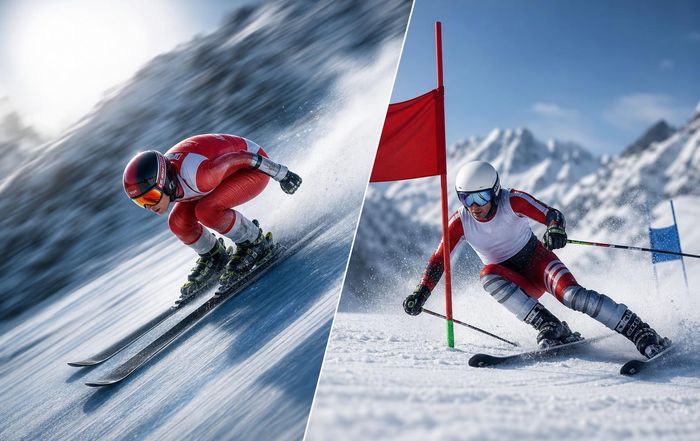
Downhill is the archetypal speed event: long courses, relatively few gates, large turns, and the highest terminal velocities. Super-G (super giant slalom) sits just behind it on the speed spectrum, with more gates and tighter turns but still emphasizing gliding and aerodynamics. Giant slalom marks the beginning of the "technical" side, with more frequent and tighter gates that demand carved turns and controlled pressure on the skis. Slalom is the technical extreme: short courses, very tight gates, rapid-fire transitions, and lower speeds but extremely high technical intensity. Combined events ask skiers to switch between speed and technical runs, testing versatility rather than specialization.
The International Olympic Committee (IOC) and FIS define these disciplines in their competition rules, but Swiss venues accentuate their contrasts. For instance, the Wengen downhill and the Wengen slalom are run on different parts of the mountain and feel almost like different sports, even though they share the same village and event week. For readers who follow broader news or science topics, the physics behind these events-gravity, friction, aerodynamics-also plays a central role in how the disciplines diverge.
Downhill in Switzerland: Maximum Speed, Minimal Margin
Swiss downhill races are showcases for speed-oriented technique. At Wengen's Lauberhorn or the Engiadina downhill in St. Moritz, athletes prioritize aerodynamic efficiency and stability over quick edge changes. The tuck position is fundamental: racers crouch with hips low, arms forward, and poles tucked close to reduce drag, a concept often explained in sports science by organizations like Swiss Ski and research institutions such as ETH Zürich and EPFL, which have studied aerodynamics in winter sports.
The technique in downhill revolves around long, gliding turns and smooth pressure control. Racers aim to keep their skis as flat as possible without sacrificing control, because every degree of edging increases friction and costs speed. On Swiss courses, which often include long gliding sections followed by compressions, jumps, and high-speed curves, skiers must anticipate terrain features well in advance. They adjust their body position to absorb bumps, maintain contact with the snow over blind crests, and land jumps in a stable, forward-driving stance. Mistiming a terrain read at 140 km/h can mean losing tenths of a second or, more seriously, risking a crash.
Safety considerations are significant at these speeds. FIS and medical organizations such as Innsbruck Medical University and the International Olympic Committee's medical commission have collaborated on research into high-speed crash dynamics, influencing netting, course preparation, and equipment regulations. In Switzerland, local organizers work with FIS and national associations to tailor safety measures to specific course features, such as the famous "Hundschopf" jump in Wengen. Downhill skis are longer and straighter than those used in other disciplines, which enhances stability but makes tight turns more difficult-another reason why downhill technique emphasizes gradual, controlled arcs rather than sudden direction changes.
The mental aspect is equally distinctive. Downhillers must memorize long courses with dozens of visually similar sections, often previewed only a handful of times. On Swiss classics, with their complex sequences and iconic landmarks, this course knowledge becomes almost a second language, passed between generations of racers and coaches.
Super-G: The Swiss Hybrid of Speed and Line Choice
Super-G in Switzerland functions as a bridge between the pure speed of downhill and the more technical disciplines. Courses in venues like St. Moritz or Crans-Montana are shorter than downhills but still fast enough to require aerodynamic tucks on flatter sections. However, gate sets are more frequent and varied, forcing racers to carve more actively rather than simply glide. Unlike downhill, there is no full-length training run in super-G; racers inspect the course visually, then commit to their line at full speed on the first and only race run. This format amplifies the importance of tactical intelligence and adaptability.
Technique in super-G on Swiss terrain emphasizes precise line choice and early pressure on the ski edges. Racers must initiate turns high and commit to them fully, because there is less room to adjust once they are in the fall line. The undulating Swiss terrain, with rolls and sidehills, means that racers often carve on uneven surfaces, requiring strong lateral balance and the ability to adjust hip and upper-body position mid-turn. Coaches and analysts from national federations such as Swiss-Ski and US Ski & Snowboard often highlight how super-G rewards racers who can quickly read terrain and gate combinations during inspection and translate that into instinctive decisions at 100 km/h.
Equipment and body positions in super-G are closer to downhill than to giant slalom, but the timing of movements is more complex. Racers still use long, relatively straight skis and spend time in a tuck, yet they must move dynamically in and out of that aerodynamic stance to handle rapid direction changes. On Swiss super-G courses, where visibility and weather in high alpine settings can change quickly, the ability to trust one's technique and inspection notes is crucial. This makes super-G a favorite among technical all-rounders such as Marco Odermatt, who blend giant slalom precision with speed-event courage.
Giant Slalom: Carving Precision on Swiss Slopes
Giant slalom (GS) is often described by coaches as the "purest" test of carved turning, and Swiss GS venues like Adelboden's Chuenisbärgli are iconic for that reason. Speeds are lower than in downhill or super-G, but still substantial-often 60-80 km/h-and the gates are set to force consistent, medium-radius turns. The focus shifts from aerodynamics to edge control, pressure management, and the ability to maintain a clean, arcing ski trajectory from turn to turn.
On steep, rolling Swiss GS hills, racers must coordinate their entire body to move smoothly across the skis. The center of mass travels on a relatively straight path down the hill, while the skis take a longer, curved route. Athletes angulate at the hips and knees to create high edge angles, allowing the skis' sidecut to carve rather than skid. This carving preserves speed and provides grip on the often-injected (water-hardened) snow used in World Cup racing. Organizations like Infront Sports & Media and broadcasters such as Eurosport and SRF frequently use slow-motion replays from Swiss GS races to illustrate these fine technical details for viewers.
Swiss GS courses are also known for rhythm changes-sections where gate spacing tightens or widens abruptly. Racers must adjust their timing and turn shape quickly without oversteering or getting late. The transition between turns becomes a focal point: athletes extend and move their hips across the skis early, creating pressure at the top of the next turn rather than waiting for the fall line. This proactive approach distinguishes top GS skiers and is a major reason why Swiss GS success often translates into strong performances on other technical courses worldwide.
Compared with speed events, GS training in Switzerland places more emphasis on repeated gate runs, video analysis, and fine-tuning body position. For readers interested in performance and fitness, GS athletes typically develop strong core stability and leg strength to handle high g-forces while maintaining precise movements. This is less about pure bravery at extreme speeds and more about executing perfect technique under pressure, especially on demanding home hills where fans expect excellence.
Slalom: Swiss Courses and the Art of Rapid Reaction
Slalom represents the technical extreme of alpine skiing, and Swiss slalom races-particularly in Wengen and Adelboden-highlight just how different this discipline is from the speed events. Slalom courses are shorter and slower in terms of absolute velocity, but the density of gates and the speed of direction changes make it one of the most physically and neurologically demanding events in sport. Athletes may navigate 55 to 70 turns in less than a minute, with each turn requiring precise timing, pole planting, and edge engagement.
On Swiss slalom hills, which are often steep and rutted by the time later racers start, technique must be both aggressive and adaptable. Racers use much shorter skis with a tighter radius, allowing quick pivoting and rapid edge-to-edge transitions. Body movements are compact and explosive: knees and ankles flex deeply, hips remain relatively close to the snow, and the upper body faces down the hill to maintain directional stability. The use of protective gear-chin guards, hand guards, shin guards, and helmets with visors-is more prominent here because athletes often strike the gates directly with their bodies and equipment.
Course sets can vary dramatically from one run to the next, even on the same Swiss slope, emphasizing versatility. Some sets favor a straighter, more direct line where racers cross-block gates aggressively; others introduce combinations such as hairpins and flushes that require subtle adjustments in rhythm and turn shape. Technical coaches and analysts, including those from national systems like ÖSV (Austria) and DSV (Germany), often study Swiss slalom races to benchmark how top athletes manage these transitions on challenging terrain.
Psychologically, slalom is unforgiving: missing a single gate or making a small timing error can end a run. Yet this very sensitivity to precision is what makes slalom technique so distinct from downhill. Where downhillers manage risk over minutes at extreme speed, slalom specialists in Switzerland manage micro-risks multiple times per second, using reflexes and drilled movement patterns to stay on line. For spectators used to broader social and culture coverage, the intensity of a slalom second run in front of thousands of Swiss fans is one of winter sport's most charged atmospheres.
Combined Events and All-Rounders: Switching Gears on Swiss Snow
Combined events-traditionally downhill or super-G plus slalom-highlight the contrast between speed and technique more explicitly than any single discipline. In Switzerland, where classic venues often host multiple races over a weekend, combined formats ask athletes to adapt from a morning speed run to an afternoon slalom, sometimes on entirely different parts of the mountain. The technical and mental shift required is significant: body positions, movement timing, and even equipment change between runs.
All-rounders who succeed in Swiss combined races typically possess a flexible technique that can be scaled toward either end of the speed-technical spectrum. For instance, a GS specialist stepping into super-G may focus on maintaining their strong carving skills while learning to stay in a tuck longer and accept higher speeds. Conversely, a downhiller working on slalom must develop quicker feet, more compact turns, and the ability to handle dense gate sets without excessive fatigue. National teams and high-performance centers, including those supported by Swiss Olympic and various national sports institutes, often use combined races to identify versatile talents early in their careers.
The equipment swap between runs reinforces how distinct the disciplines are. Athletes change not only skis but also binding positions, boot setups, and sometimes even protective gear. In the Swiss context, where weather can shift rapidly in the mountains, combined racers must also adapt to changes in visibility, snow texture, and temperature between runs. This multi-variable challenge underscores how speed and technique are not fixed traits but adjustable dimensions that athletes must manage consciously.
For readers interested in the broader business and sponsorship side of sport, combined events also appeal to broadcasters and sponsors because they keep audiences engaged across multiple race sessions, showcasing different aspects of an athlete's skill set on the same day.
How Training in Switzerland Reflects Discipline-Specific Demands
Swiss training environments, from junior clubs to World Cup teams, are structured around the distinct demands of each discipline. Young athletes often start with a heavy emphasis on technical events-slalom and giant slalom-to build strong foundational skills before gradually introducing speed disciplines. This progression aligns with recommendations from bodies like Swiss-Ski, US Ski & Snowboard, and educational resources from organizations such as Snow Sports NZ, which emphasize technical fundamentals and safety for developing racers.
For speed events, Swiss programs incorporate gliding exercises, jump training, and terrain reading drills on longer slopes. Athletes learn to maintain a stable tuck, manage compressions, and land jumps in balance. Strength and conditioning programs, sometimes designed in collaboration with institutes like Swiss Federal Institute of Sport Magglingen (SFISM), focus on leg power, core stability, and impact resilience. Video analysis of classic Swiss downhills helps athletes understand line choice and how small technical adjustments affect speed over several minutes of racing.
Technical training in Switzerland is more gate-intensive and detail-oriented. Slalom sessions emphasize quick feet, pole-plant timing, and maintaining upper-body discipline while the legs work independently. GS training focuses on carving, edge angle development, and learning to handle rhythm changes, often on injected or icy surfaces to replicate World Cup conditions. Coaches use high-speed cameras and timing systems to measure how changes in technique translate into time gains or losses, a practice mirrored by high-performance programs worldwide and discussed in coaching materials from organizations like the International Ski Instructors Association (ISIA).
At the elite level, specialization becomes more pronounced. Some Swiss athletes commit primarily to speed or technical events, tailoring their physical preparation, equipment choices, and race schedules accordingly. Others aim to remain competitive across multiple disciplines, which demands careful management of fatigue, travel, and training focus. This balance between specialization and versatility is a recurring theme in modern alpine skiing, particularly in countries like Switzerland that field strong contenders in every discipline.
Why These Differences Matter for Fans and Future Racers
Understanding how Swiss alpine races differ in speed and technique changes how one watches the sport. Downhill is not just about who is bravest; it is about who can maintain the cleanest line, most stable tuck, and best terrain management at extreme velocity. Super-G rewards tactical intelligence and the ability to commit to a line after a single inspection. Giant slalom celebrates carving purity and rhythm adaptation on demanding slopes. Slalom showcases reflexes, precision, and consistency under intense pressure. Combined events reveal who can switch between these modes effectively on the same day.
For aspiring racers and coaches, Swiss venues offer a kind of living laboratory where these distinctions are visible in high definition. Watching how top athletes adjust their stance, turn shape, and line from one discipline to another provides practical lessons in technique and race strategy. For broader sports followers, these differences also illuminate why some athletes dominate overall World Cup standings while others become specialists in a narrow band of events.
Beyond the race hill, the spectrum from speed to technique in Swiss alpine skiing intersects with themes that interest many readers: performance optimization, risk management, sports science, and even how technology and equipment evolve under regulatory oversight from bodies like FIS and the IOC. As winter sports continue to develop-with advances in safety gear, course preparation, and athlete support systems-the fundamental contrasts between disciplines on Swiss snow remain one of the sport's most compelling storylines.
Whether watching a racer plunge down the Lauberhorn at highway speeds or dance through Adelboden's slalom gates in front of a roaring crowd, recognizing how speed and technique shift from event to event makes every run richer, more nuanced, and far more than just a race against the clock.