

How Italian Volleyball Teams Use Rotations and Positioning to Win Rallies
Italian volleyball has a reputation for tactical sophistication as much as for technical skill. From the men's SuperLega to the women's Serie A1, coaches and players treat rotations and positioning almost like a chess problem played at full speed. For viewers used to focusing on big serves or thunderous spikes, the subtler work of building lineups, manipulating matchups, and shifting defensive schemes can be easy to miss, yet it often decides close matches and championships.
This article looks at how top Italian club teams and the Italian national sides use rotations and positioning as strategic tools rather than just rule-driven necessities. It draws on trends visible in elite European play, guidance from organizations such as the FIVB and CEV, and the tactical habits that have made Italian clubs fixtures in the latter stages of the Champions League and Club World Championship. The aim is to help sporty fans understand not just what is happening on the court, but why - and how these ideas connect to broader performance themes in sports, fitness, and sports science.
The tactical foundations: Italian interpretations of the rotation rules
At the most basic level, all high-level volleyball follows the same rotation rules: six players cycle clockwise through six zones, back-row players cannot attack from in front of the three-metre line, and positional faults occur if players overlap illegally at serve. What distinguishes Italian teams is how deliberately they build their systems around these constraints, using rotations as a framework for offensive and defensive identity rather than treating them as a fixed pattern.
Coaches in Italy typically design their lineups to maximize the number of rotations in which their strongest attacker hits from the front row with the primary setter in the front or back row depending on the team's philosophy. Some teams, for instance, prefer to align their star opposite hitter in Rotations 1 and 6 to attack against the opponent's smaller wing blocker, while others emphasize having their best middle available to tempo sets when the setter is front row and can threaten with dumps. Because the FIVB rules require players to respect their rotational order only until the ball is served, Italian sides exploit the moment the serve crosses the net to flow quickly into pre-planned offensive and defensive positions.
This mindset is supported by extensive video analysis and data. Clubs such as Sir Susa Vim Perugia and Itas Trentino are known for using advanced scouting, often with help from tools promoted by organizations like Data Volley and analytics frameworks discussed through outlets such as VolleyBallWorld and CEV. They track side-out efficiency, break-point efficiency, and error rates by rotation, then adjust lineups or substitution patterns to protect weaker phases. Over a season, even a small gain in one difficult rotation can translate into several extra wins in tight league and European fixtures.
Rotation-by-rotation: how Italian teams build offensive systems
While every coach has personal preferences, Italian clubs often share a few structural ideas about how to attack from each rotation, especially in the men's SuperLega where serving and blocking pressure are extreme. Rather than memorizing a rigid playbook, players learn a menu of options that vary by rotation, opponent block scheme, and in-rally situation.
In rotations where the setter starts in Zone 1 (back-right) or Zone 6 (back-middle), Italian teams commonly emphasize fast-tempo sets to the outside hitter in Zone 4 and quicks to the middle in Zone 3. This reduces the distance the setter must travel and keeps the offense stable under heavy serve pressure. When the setter is front row in Zone 2 (right-front), many Italian systems become more complex, layering in back-row attacks from Zones 1 and 6, slides or "C" balls behind the setter, and occasional dumps to punish passive blockers. The presence of three front-row attackers plus one or two live back-row options allows coaches to challenge specific matchups, such as forcing a weaker opposing blocker to choose between helping on the middle or closing the line against a powerful opposite.
Italian women's clubs in Serie A1, like Imoco Conegliano and Vero Volley Milano, often show a slightly more balanced spread between outside hitters and opposites, but the rotation logic is similar: they design patterns to ensure that their best scorers receive the highest share of sets in rotations where they are most efficient. Against strong serving teams, coaches may simplify the offense in their most fragile rotations, prioritizing high, reliable sets to a physical outside hitter and quick outlets to the middle only when the pass is perfect. In more favorable phases, they open the playbook, calling combination plays such as "X" (crossing routes between middle and opposite) or pipe attacks from the back row to isolate blockers.
Positioning after serve: from static rotation to dynamic attack
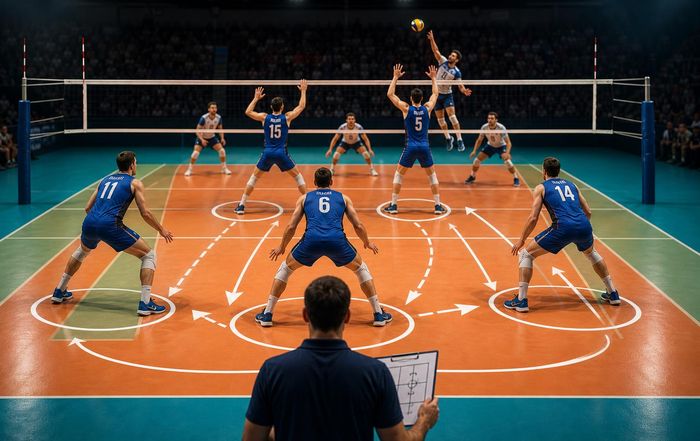
Once the server has contacted the ball and the risk of overlapping faults disappears, Italian teams move rapidly into their "base" or "spread" offensive positions. This transition is where positioning becomes a weapon. Players do not simply drift to comfortable spots; they follow choreographed patterns designed to improve attacking angles, protect weaker passers, and disguise the set distribution.
A common Italian pattern is the three-person or even four-person receive formation, with the libero and two primary outside hitters taking the majority of the court. The opposite hitter and middle blockers are often "hidden" from serve receive, starting closer to the net or near the sideline, then sprinting into their attacking lanes once the ball is passed. This allows the team to keep its most dangerous attackers fresh and focused on timing, while the most stable ball-handlers absorb the serving pressure. The principle mirrors broader high-performance trends in fitness and load management, where roles are specialized to reduce unnecessary strain.
Italian setters, many of whom have been schooled through the national federation's development pathways under FIPAV (the Italian Volleyball Federation, accessible via federvolley.it), are particularly adept at using their starting positions to hide intentions. They may set from slightly different depths or angles depending on rotation, giving themselves more options to attack seams in the block. Meanwhile, middles adjust their starting spots by a step or two based on the opponent's serving tendencies, ready to run a first-tempo quick if the pass is perfect or to delay and create a "gap" attack if the pass drifts off the net. Over time, these micro-adjustments create a fluid attack that looks less predictable than the rigid systems seen in some domestic leagues.
Defensive positioning: Italian block-defense systems and reading the game
If offense is about building options, defense in Italian volleyball is about eliminating them. Teams in both SuperLega and Serie A1 invest heavily in coordinated block-defense systems, with positioning tailored not just to the opponent's hitters but to the tendencies of individual setters and passers. Italian defenses rarely sit in a pure "read" or "commit" scheme; instead, they blend elements of both, shifting from rotation to rotation and even rally to rally.
On the block, Italian coaches often assign clear responsibilities based on scouting reports gathered from platforms like FIVB and CEV. For example, if an opposing outside hitter prefers sharp cross-court swings, the line blocker may start slightly more inside, trusting the defender in Zone 1 to handle tips and high lines. Conversely, against an opposite who likes to hit high off the hands, the outside blocker may be instructed to penetrate more aggressively with closed hands to reduce deflections. These details affect where back-row defenders position themselves: liberos might shade a step deeper against heavy hitters or move closer to the ten-foot line against teams that use more roll shots and tips.
Italian teams also place significant emphasis on transition defense, especially in rotations where their blocking matchups are less favorable. After serving, players sprint to pre-agreed "base" positions that vary by rotation. For instance, in Rotations 1 and 6, where outside blockers may be smaller, the team might emphasize funneling attacks toward the libero by taking away line shots and leaving more cross-court space to be dug. This mirrors tactical thinking seen in other invasion sports covered in our culture and social sections, where teams steer play toward their strongest defenders rather than trying to cover everything equally.
Matchups and substitutions: using the rotation to hunt weaknesses
One of the most visible ways Italian teams exploit rotations is through matchup hunting. Because the receiving team chooses its starting formation within the constraints of the rotation order, coaches can adjust lineups to create favorable pairings, such as a tall outside hitter attacking against a shorter setter in the front row or a strong server targeting a weaker receiver in a specific zone.
In SuperLega, where many teams carry two high-level opposites or multiple outside hitters of contrasting styles, coaches use double substitutions and situational changes to optimize these matchups. A common pattern is the "double sub," where the starting setter and opposite are replaced by a backup setter and opposite when the starting pair rotates to the front row. This allows the team to maintain three front-row attackers while keeping a taller blocker in the front line and preserving the primary setter for back-row rotations, where their setting and defense may be more valuable. Clubs like Lube Civitanova and Modena Volley have used this tactic extensively, mirroring trends also seen in international play by national teams tracked on platforms like Olympics.com.
Italian women's teams frequently use serving and defensive specialists to stabilize specific rotations. If a particular outside hitter struggles in receive when passing from Zone 1, a coach might substitute a defensive specialist for that single rotation against a tough server, then reverse the change once the team regains the initiative. Over the course of a long season with domestic and European commitments, such micro-optimizations help maintain consistency and reduce the mental pressure on individual players, supporting the broader performance and health of the squad.
The role of the libero: anchoring receive and defense across rotations
The introduction of the libero in the late 1990s reshaped volleyball globally, but the position has become especially central in Italian tactical thinking. Libero specialists such as Massimo Colaci and Monica De Gennaro have demonstrated how a world-class backcourt player can influence rotations far beyond simply replacing middle blockers in the back row.
Italian teams typically use the libero not only to upgrade passing quality but to stabilize problematic rotations. For example, in a rotation where a weaker passer is forced into the serve-receive pattern, the libero might take a significantly larger share of the court, sometimes covering two-thirds of the back row. The rest of the formation shifts accordingly: outside hitters slide closer to the sidelines to protect seams, and the setter may start slightly deeper to receive high passes without colliding with the libero. This is especially evident in pressure situations, such as fifth sets or crucial Champions League rallies, where Italian teams trust their liberos to handle the most difficult serves.
Defensively, the libero's positioning changes subtly by rotation. In some schemes, the libero plays middle-back, reading tips and hard-driven balls off the block; in others, particularly against powerful opposites, the libero might defend left-back to cover line shots and sharp angles. Italian coaches teach liberos to read hitter approach, shoulder angle, and set tempo, skills that are increasingly supported by video and data tools promoted by organizations like FIVB and high-performance institutes such as CONI, Italy's national Olympic committee. This blend of intuition and analytics exemplifies how Italian volleyball fuses tradition with modern sports technology.
Training the system: how Italian clubs teach rotations and positioning
The sophisticated use of rotations and positioning seen on match days is the product of highly structured training environments. Italian clubs often dedicate entire sessions to rotation-specific drills, running serve-receive patterns repeatedly from each rotation with defined scoring targets. For example, a team might work on Rotations 1 and 6 until it can side-out above a certain percentage, with the drill resetting whenever communication or positioning errors occur. This approach mirrors broader performance methodologies used in elite sports training, where practice design closely simulates game realities.
Video analysis is another pillar. Many teams review clips organized by rotation, allowing players to see how their spacing and responsibilities change across the six phases. Coaches highlight not only technical errors but also small positional lapses, such as a middle starting one step too far from their blocking assignment or a defender creeping out of their designated lane. Over time, these reviews help players internalize the "map" of the court for each rotation, so they can adjust instinctively in real time.
Youth academies affiliated with Italian clubs and the national federation also emphasize rotation literacy from an early age. Young setters are taught to think several rotations ahead, considering how their decisions in one rally affect matchups in the next. This systems-based education helps explain why Italian volleyball consistently produces tactically mature players, many of whom later become coaches or analysts themselves, feeding back into the ecosystem and influencing how the sport is played worldwide. For readers interested in how sport-specific education intersects with jobs and careers in sport, Italian volleyball offers a compelling case study.
International influence: how Italian rotation strategies shape global play
Because Italian leagues attract many of the world's best players and coaches, the way Italian teams use rotations and positioning often spreads quickly to other countries. Foreign players who spend seasons in SuperLega or Serie A1 carry these tactical habits back to their national teams, contributing to a global homogenization of certain systems - but also to ongoing innovation as other federations adapt and respond.
For instance, the emphasis on heavy back-row offense from Rotations 1 and 6, once more common in Italian men's play, has now become standard in many national teams across Europe, Asia, and the Americas. Similarly, the flexible use of the double substitution, once a hallmark of a few Italian clubs, has been widely adopted at the highest levels. International governing bodies such as FIVB and continental confederations like CEV monitor these tactical evolutions as part of broader discussions on rule changes, competition formats, and the balance between offense and defense.
At the same time, Italian teams are influenced by innovations from abroad, including the ultra-fast tempo offenses popularized in parts of Asia and the physical, serve-dominant style honed in some North and South American programs. This constant exchange underscores how rotations and positioning are not static concepts but living elements of a sport that continues to evolve. For fans who follow wider world sports news, Italian volleyball serves as a useful lens for understanding how tactical ideas circulate and adapt across leagues and cultures.
What players and coaches elsewhere can learn
For players and coaches outside Italy, the specific patterns used by Italian teams may not be directly transferable due to differences in player profiles, league rules, or training time. However, several underlying principles are widely applicable. First, treat rotations as a strategic resource, not just a rule to follow. Mapping out which rotations are strong or weak, and why, can guide practice priorities and substitution strategies. Second, align positioning with individual strengths: hide weaker passers when possible, funnel attacks toward your best defenders, and design offensive patterns that give your strongest hitters the ball in their best situations.
Third, use data and video, even at modest levels of competition. While most clubs will not have the resources of a SuperLega powerhouse, simple tracking of side-out percentages by rotation or heat maps of where serves land can reveal actionable trends. Free or low-cost analytics tools, combined with guidance from reputable sources like FIVB and educational content from organizations such as USA Volleyball or Volleyball England, can help coaches structure training more effectively. Finally, remember that tactical sophistication does not replace fundamentals; Italian systems work because they are built on high technical standards in serving, passing, and setting.
For readers who follow not only volleyball but also broader themes in sports business and performance, Italian volleyball's approach illustrates how a clear tactical philosophy, supported by data and long-term player development, can create sustainable competitive advantages in a crowded global sports landscape.
Italian volleyball's use of rotations and positioning shows that the sport's geometry is as important as its power. By treating each rotation as a distinct strategic moment and using positioning to highlight strengths and mask weaknesses, Italian clubs and national teams extract maximum value from every rally. For anyone watching a SuperLega or Serie A1 match, paying attention to how players move the instant the serve crosses the net - and how those patterns change from rotation to rotation - offers a richer, more nuanced appreciation of why the ball so often seems to find the right hands at the right time.