

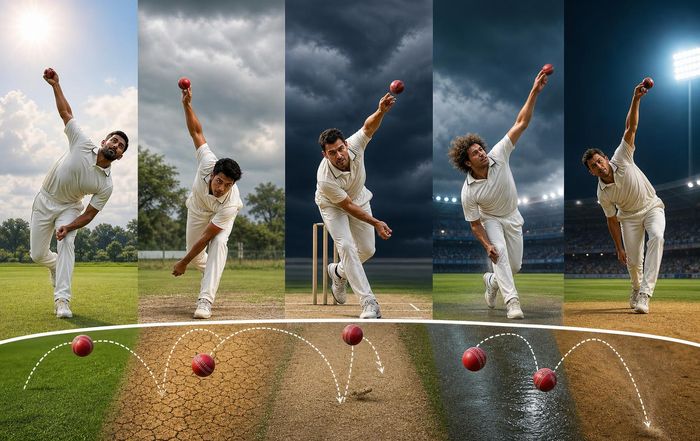
A Guide to Cricket Bowling Styles and Match Conditions
Cricket looks very different depending on who has the ball in hand and what the pitch and weather are doing. For anyone trying to understand why a Test match drifts into a slow grind, why a T20 game explodes in the final overs, or why some bowlers thrive in England and struggle in India, the interaction between bowling styles and match conditions is the key.
This guide breaks down the major bowling types, explains how they work technically, and shows how conditions across formats and countries shape tactics and selection.
The fast bowling spectrum: pace, seam and swing
Fast bowling is not one style but a spectrum that runs from pure speed to subtle movement off the pitch and through the air. Modern coaching bodies like the ICC and national boards such as the England and Wales Cricket Board describe three broad categories: out-and-out fast, fast-medium, and medium pace, with plenty of overlap.
At the quickest end are genuine fast bowlers, often exceeding 145 km/h. Their primary weapons are speed, bounce and intimidation. On hard, bouncy pitches such as those historically found in Australia and South Africa, these bowlers can attack with short balls (bouncers), hit-the-deck length and aggressive fields. On slower subcontinental surfaces, the same bowlers may have to pitch fuller, hunt for reverse swing, and use changes of pace. Fast-medium bowlers, typically in the 130-140 km/h range, rely more on movement through the air (swing) and off the seam. They become particularly dangerous under cloud cover or with a new ball that retains its lacquer, conditions that often appear in England or New Zealand.
Seam bowling focuses on exploiting the raised seam of the ball to create deviation after pitching. Seamers try to land the ball on the seam with an upright wrist, producing unpredictable movement either away from or into the batter. Grass on the pitch, moisture, and a slightly soft surface can all enhance seam movement, while dry, bare pitches tend to reduce it. Swing bowling, by contrast, is about aerodynamics: bowlers position the seam and polish one side of the ball so that air flows differently on each side. According to work popularized by researchers at Loughborough University and others, factors such as seam angle, ball speed, humidity and wind can all influence swing. Conventional swing usually occurs when the ball is relatively new, while reverse swing can appear when one side is heavily roughened, especially at higher speeds.
For followers tracking international cricket across formats, understanding these distinctions explains why some bowlers are selected for Tests but not T20s, or why captains in franchise leagues around the world invest heavily in opening-burst specialists as well as death-overs experts. It also underpins how fans interpret bowling figures when following scorecards on global media such as ESPNcricinfo or BBC Sport.
For broader context on how fast bowling fits into the wider sports landscape, SportSyncr readers can also explore our dedicated sports coverage and world news section, where conditions and performance trends across different countries are often compared.
Short-ball tactics, yorkers and variations in limited-overs cricket
Beyond basic pace and movement, modern fast bowlers are defined by how they use specific deliveries and variations, particularly in one-day and T20 formats. In Tests, bowlers can work patiently with a consistent length just outside off stump, but in white-ball cricket they must constantly change the batter's visual cues and timing.
The short ball (bouncer) remains a central weapon, but its use is tightly regulated. The ICC Playing Conditions limit the number of short-pitched deliveries per over in many formats, and umpires monitor dangerous bowling. On fast, bouncy surfaces, captains may employ sustained short-ball tactics with leg-side fields to force mistakes, while on lower, slower pitches a barrage of bouncers is less effective and more likely to sit up to be hit. The yorker-aimed at the batter's toes or base of the stumps-is the opposite extreme, especially valuable at the "death" in T20 and ODI cricket. Executing yorkers consistently is technically demanding: a slight error in length can turn a perfect ball into a half-volley or full toss, so bowlers often mix them with slower balls and wide yorkers to protect predictable patterns.
Variation balls have grown in importance with the expansion of domestic T20 leagues, from the Indian Premier League to competitions in Australia, England, and beyond. Slower balls can be delivered using back-of-the-hand releases, off-cutters and leg-cutters, or by simply rolling the fingers over the seam. These deliveries exploit batters' attempts to hit hard through the line, especially on pitches where the ball grips. The knuckle ball, popularized in the last decade, further disrupts pace without obvious changes in action. Analysts at organizations like CricViz have highlighted how these variations can dramatically alter expected scoring rates, especially in the final overs.
From a tactical perspective, conditions strongly influence which variations are chosen. On a sticky surface with some grip, seam-off-cutters into the pitch can be hard to hit; under lights with a slick white ball and a dewy outfield, skidding slower balls and wide yorkers may be safer. Readers who follow broader trends in sports technology will recognize how data analytics and ball-tracking tools are now routinely used to map which variations succeed in specific venues and weather patterns.
Classical spin: finger spin and wrist spin
Spin bowling introduces a different way of winning the contest: instead of rushing the batter, spinners manipulate flight, dip, drift and turn. Governing bodies such as the Board of Control for Cricket in India (BCCI) and Cricket Australia routinely emphasize spin development in their high-performance programs, especially for longer formats and subcontinental conditions.
Finger spinners-traditionally off-spinners (right-arm, spinning from off to leg to a right-hander) and left-arm orthodox spinners (left-arm, spinning from leg to off)-use their fingers to impart rotation. They generally bowl slightly faster than wrist spinners and rely on accuracy, subtle changes of pace and trajectory, and the ability to hit a consistent length. On dry, abrasive pitches, especially in India, Pakistan, Sri Lanka and parts of the Middle East, these bowlers can extract significant turn and variable bounce, making them central to Test strategies. In white-ball cricket, finger spinners often bowl defensive lines, such as wide of off stump, aiming to restrict scoring with packed off-side fields.
Wrist spinners-leg-spinners (right-arm, spinning from leg to off to a right-hander) and left-arm unorthodox or "chinaman" bowlers-use their wrists to generate stronger revolutions, which can produce more dramatic turn and pronounced dip. The trade-off is control: wrist spin is harder to master, and loose deliveries can be punished, particularly in T20 cricket. Yet, when conditions offer even modest grip, a quality wrist spinner can be a match-winner. The leg-break, googly (wrong'un), top-spinner and slider each present different trajectories and angles, forcing batters to read the hand and seam position quickly.
Because spin bowling is so sensitive to surface conditions, curators and boards must balance competitive fairness and entertainment. Reports and guidelines from bodies like the Marylebone Cricket Club (MCC) stress the importance of "good" pitches that provide something for both bat and ball. Excessively dry, crumbling surfaces can create unplayable spin, while overly green, moist pitches marginalize spinners and tilt too far toward seamers. For readers interested in how this intersects with broader sporting culture and business, our culture and business sections often explore the economic and broadcasting implications of pitch preparation.
Mystery spin and the rise of hybrid bowlers
The growth of global T20 leagues has accelerated the evolution of "mystery" spinners and hybrid bowling styles. These bowlers blur traditional categories, using unusual grips, actions or angles to make the ball's spin direction and pace harder to read. Examples include off-spinners who bowl a carrom ball flicked with the middle finger, leg-spinners with disguised sliders and back-spinners, and left-arm unorthodox bowlers who can bowl both stock leg-breaks and off-spin-style deliveries.
From a technical perspective, mystery spin often involves manipulating the seam and wrist at the last moment, while keeping the arm path and run-up consistent. Batters rely on cues such as wrist position, seam angle, and release point, so disguising these cues is critical. High-speed video analysis and biomechanics labs, such as those used by Cricket Australia and other boards, have helped refine these skills, but they have also allowed analysts and opposition coaches to decode some of the mystery over time.
Conditions again play a major role. On slow, turning pitches, mystery spinners can be devastating, particularly in the middle overs of T20s when batters are trying to accelerate without losing wickets. On flat, low-turning surfaces, their advantage shrinks, and their higher risk of bowling boundary balls becomes more pronounced. As a result, franchise teams often choose when to deploy these bowlers based on venue, opponent, and even ball manufacturer. For fans following global tournaments via outlets such as Sky Sports or Fox Sports, understanding this nuance clarifies why some "star" mystery spinners sit out matches in certain conditions despite impressive reputations.
Mystery and hybrid styles also intersect with regulatory oversight. The ICC and national boards monitor bowling actions to ensure they comply with legal flexion limits at the elbow. Some unorthodox actions have prompted scrutiny and, in some cases, remodeling. This regulatory framework is part of a broader integrity landscape that also covers sports governance and social issues, especially when questions of fairness and technology arise.
Match formats: how Tests, ODIs and T20s shape bowling
Bowling styles cannot be fully understood without considering match formats. The demands of a five-day Test, a 50-over ODI, and a 20-over T20 differ so much that many modern bowlers specialize, while a smaller group adapts across formats.
In Test cricket, bowlers work in longer spells, build pressure over many overs, and use the evolving condition of the ball and pitch. Fast bowlers may start with a new ball that swings conventionally, shift to a more seam-based plan as the ball softens, and then hunt reverse swing when one side becomes rough. Spinners often become more influential as the pitch wears, cracks, and loses moisture. Captains can set attacking fields with multiple slips and close catchers because the format rewards patience and values wickets more than run rate. This context favors technically sound, repeatable actions and fitness levels that allow sustained spells, an area where sports science research from institutions such as the Australian Institute of Sport and UK Sport has become central.
In ODIs, bowlers operate under fielding restrictions and over limits. Powerplays with only two or three fielders outside the circle encourage aggressive batting, so new-ball bowlers must balance wicket-taking lines with protection against boundaries. Middle-overs bowlers, often spinners or change-of-pace seamers, focus on controlling the scoring rate and creating errors through dot-ball pressure. At the death, specialists must execute yorkers, slower balls and wide lines under intense pressure. The white ball tends to swing less and lose its shine quickly, which can reduce some forms of movement but also make gripping slower balls harder, especially when dew is present.
T20 intensifies these dynamics. With only four overs per bowler, captains frequently use short, high-impact spells. Match-ups-left-arm angle to a right-hander, leg-spin to a left-hander, and so on-drive selection and in-game changes. Bowlers must accept that even good deliveries can go for boundaries; the goal is to win key moments rather than maintain low economy throughout. Mystery spin, extreme pace, deceptive slower balls and wide yorkers are highly prized. Analytics firms like Hawk-Eye and data-driven teams have reshaped how franchises think about optimal lengths and lines in these formats.
For readers interested in how these evolutions echo across other sports, our gaming coverage often touches on how cricket video games model these tactical differences, while news and analysis sections regularly track format-specific trends in international series.
Pitches, weather and geography: why conditions matter so much
Cricket is unusually sensitive to environmental factors. A fast bowler's effectiveness in one country can be transformed when they tour another, and spinners who dominate at home may struggle abroad. Governing bodies, including the ICC, publish detailed pitch and outfield guidelines, but local climate and soil still create strong regional identities.
Pitch composition is fundamental. Surfaces with a high clay content can crack and take spin as a match progresses, while sandier or grassier pitches may favor seam movement and consistent bounce. Grass coverage, rolling, and watering schedules all influence how the ball behaves. In England and New Zealand, cooler climates and regular moisture often produce green-tinged surfaces that help seamers. In India and parts of the subcontinent, drier, hotter conditions encourage pitches that start true but break up into dust and cracks, bringing spinners into the game from day three onwards. In Australia and South Africa, historically harder, bouncier pitches have suited fast bowlers, though modern drop-in pitches and evolving curation practices have begun to narrow some of these differences.
Weather overlays another layer. Cloud cover can enhance swing by affecting air density and ball behavior, a phenomenon often discussed by broadcasters like Channel 7 in Australia and Sky Sports in the UK. Humidity and wind direction can also matter. Dew, particularly in day-night white-ball matches in Asia and other warm climates, can heavily favor the team batting second by making the ball slippery for bowlers and reducing grip for spinners. Captains factor this into decisions at the toss, sometimes choosing to chase even on pitches that might otherwise favor batting first.
Geography also intersects with environmental concerns. As climate patterns shift, boards and researchers, including organizations such as the United Nations Environment Programme (UNEP), have raised questions about how rising temperatures and more erratic rainfall could alter pitch preparation, player workloads and match scheduling. For readers interested in these crossovers, SportSyncr's environment and science pages often examine how climate and technology are reshaping global sport.
Ball condition, maintenance and reverse swing
The cricket ball itself evolves across an innings, and bowlers' ability to manage that evolution is central to strategy. Laws maintained by the MCC allow fielding sides to polish the ball on their clothing and remove mud, but prohibit artificial alteration such as scratching with foreign objects or using saliva with substances. The ICC has enforced these laws with increasing rigor, especially after high-profile ball-tampering incidents, and since the COVID-19 pandemic it has also restricted the use of saliva for health reasons, encouraging teams to rely solely on sweat and natural wear.
In the early overs, the ball's shiny lacquer and pronounced seam support conventional swing and seam movement. Fast bowlers typically target full lengths and attacking fields. As overs pass, the seam softens, the shine dulls, and movement decreases. At this stage, captains may introduce spinners or medium pacers to exploit any grip or variable bounce and to control the scoring rate. In longer formats, once one side of the ball becomes significantly rough while the other remains relatively smooth, reverse swing can appear-especially at speeds above about 135 km/h. Reverse swing moves the ball in the opposite direction to conventional swing relative to the shiny side, and can be particularly dangerous with an older ball on abrasive surfaces.
Match conditions affect how quickly the ball reaches this stage. Dry, dusty outfields and hard pitches can rough up one side faster, while lush outfields and softer surfaces keep the ball newer for longer. In ODIs, the use of two new balls (one from each end) since 2011 has changed dynamics, reducing late-innings reverse swing but maintaining more consistent hardness and pace off the surface. These nuances are often discussed by analysts on platforms like Cricbuzz and The Guardian, helping fans interpret why a particular spell suddenly becomes unplayable after 40 overs in a Test.
Understanding ball condition is also important for player health and performance. Fast bowlers may adjust their effort levels depending on how much assistance the ball is offering. When conditions provide little movement, bowlers must generate more effort through the body, potentially increasing injury risk. Sports science coverage in our health and fitness sections often highlights how workload management and rotation policies are used to protect fast bowlers' careers.
Tactical match-ups: right-handers, left-handers and field settings
Beyond raw conditions, captains and bowlers constantly think in terms of match-ups: which bowling style is most likely to trouble a particular batter, and how should the field be set to support that plan. This tactical layer is particularly visible in televised T20 leagues but is just as important in Tests and ODIs.
Against right-handed batters, right-arm fast bowlers who can angle the ball across from over the wicket and then bring it back in with seam or swing are highly prized. They can attack the outside edge with slips and a gully, or target the pads and stumps with in-swing and straighter fields. Left-arm fast bowlers add natural variation, swinging the ball across the right-hander and into the left-hander, creating different challenges. Similarly, left-arm orthodox spinners turning the ball away from right-handers (and into left-handers) provide a different angle from off-spinners. Leg-spinners are often deployed against aggressive right-handers because turning the ball away from the bat increases the chance of edges and miscues.
Field settings must reflect both the bowler's plan and the conditions. On a seaming pitch with plenty of lateral movement, captains may keep multiple slips and a short leg even in limited-overs cricket if early wickets are the priority. On flat T20 pitches, they may instead protect the straight and leg-side boundaries with deep midwicket, long-on and long-off, trusting slower balls and wide lines to funnel shots into these zones. For spinners, close catchers like slip, leg slip and silly point become more common as the pitch deteriorates in Tests, while in ODIs and T20s captains often opt for a ring of fielders on the off side to cut off singles and build pressure.
Advanced analytics, similar to those used in other professional sports and covered in our business and sponsorship reporting, now help teams quantify how certain match-ups perform historically. Databases maintained by organizations such as Opta support decisions like holding a particular leg-spinner back to bowl at a left-hander-heavy middle order or saving a left-arm quick specifically for a top-order right-hander who struggles with the angle.
Player development: adapting style to conditions and formats
For developing cricketers and coaches, the interplay between bowling style and conditions is not just theoretical-it shapes training, workloads and career paths. National boards like Cricket South Africa, New Zealand Cricket and others emphasize that young bowlers should build a strong technical base and physical robustness before specializing too narrowly. However, as players move into professional systems, conditions at their home grounds and the dominant formats in their domestic competitions often steer them toward particular skills.
Fast bowlers from countries with green, seaming pitches may naturally focus on hitting a good length and exploiting lateral movement, while those from spin-friendly regions might prioritize reverse swing and subcontinental-style lengths. Spinners raised on turning tracks can sometimes struggle when they first encounter flatter pitches abroad, where they must learn to vary pace and trajectory and rely more on deception in flight than sharp turn. Conversely, seamers used to movement may have to add slower balls, cutters and cross-seam deliveries to succeed on placid surfaces.
Sports science and technology support this adaptation. High-performance centers use motion capture, GPS tracking and workload monitoring to balance training intensity with injury prevention, particularly for fast bowlers who are vulnerable to stress fractures and soft-tissue injuries. Organizations such as the International Society of Biomechanics in Sports and national institutes of sport publish research that informs bowling action refinement and conditioning programs. For readers interested in sports careers and pathways, our jobs and careers coverage often highlights how these high-performance environments influence professional opportunities.
At the same time, the global cricket economy-broadcast deals, sponsorships and franchise leagues-creates incentives for bowlers to develop T20-friendly skills such as yorkers, slower balls and powerplay effectiveness. This can sometimes conflict with the patience and endurance required for Test success. Balancing these competing demands is now a central challenge for boards, players and agents, one that regularly features in broader sports business debates.
Bringing it together: reading a match through the bowlers' eyes
Once the main bowling styles and match conditions are understood, watching or following cricket becomes a more layered experience. Instead of seeing only runs and wickets, viewers can interpret why a captain opens with spin on a damp morning, why a seamer moves around the wicket to a left-hander, or why a team chooses to bowl first in a day-night ODI despite a seemingly flat pitch.
Fast bowlers, seamers, swing specialists, finger spinners, wrist spinners and mystery bowlers all bring distinct tools, but none of them operate in a vacuum. The pitch's hardness and grass, the ball's age and manufacturer, the humidity and wind, the match format, and the specific batters at the crease all combine to shape what happens from one over to the next. For international followers who drop into series in different parts of the world, this framework explains why a bowler can look unplayable in one tour and ordinary in another.
As cricket continues to evolve-through new formats, changing climates and advances in technology-the relationship between bowling styles and conditions will remain central to how the sport is played and understood. For anyone looking to stay synchronized with those shifts, keeping an eye not just on who is bowling, but on where, when and with what ball, is one of the most rewarding ways to watch the game.